
Demand generation marketing is all about creating genuine excitement and interest in what your company offers. It’s a long-term play. Instead of pushing for an immediate sale, you’re focused on building awareness, educating your audience, and positioning your brand as a trusted authority. The goal is to be top-of-mind before a prospect is even thinking about buying.
Understanding Demand Generation Marketing
Think of your marketing like hosting a neighborhood block party. Lead generation is just one task: selling tickets at the gate to people who are already lined up.
Demand generation, on the other hand, is the entire process of planning that party. It’s sending out cool invitations, creating a buzz with music people can hear down the street, and letting amazing food smells draw everyone in. You’re creating an event so compelling that people want to show up, which makes selling those tickets a whole lot easier later.
This approach is designed to make your brand the go-to resource in your field. It warms up the market so that when potential customers are finally ready to buy, your company is the first one they think of. It’s a huge shift from older marketing models that were all about quantity over quality.
The Evolution From Volume to Value
In the past, marketing success was often measured by the sheer number of leads you could stuff into a spreadsheet. Today, things are completely different.
Demand generation has become a sophisticated, data-driven discipline. We’ve moved beyond just grabbing leads to carefully nurturing them throughout their entire journey. Modern companies now prioritize the quality of a lead and use multi-touch attribution, recognizing that a buyer interacts with a brand across many channels before making a decision. You can explore more about this full-funnel approach to see how data shapes today’s most successful strategies.
This concept map shows how demand generation acts as the foundation for both building brand awareness and nurturing potential leads.
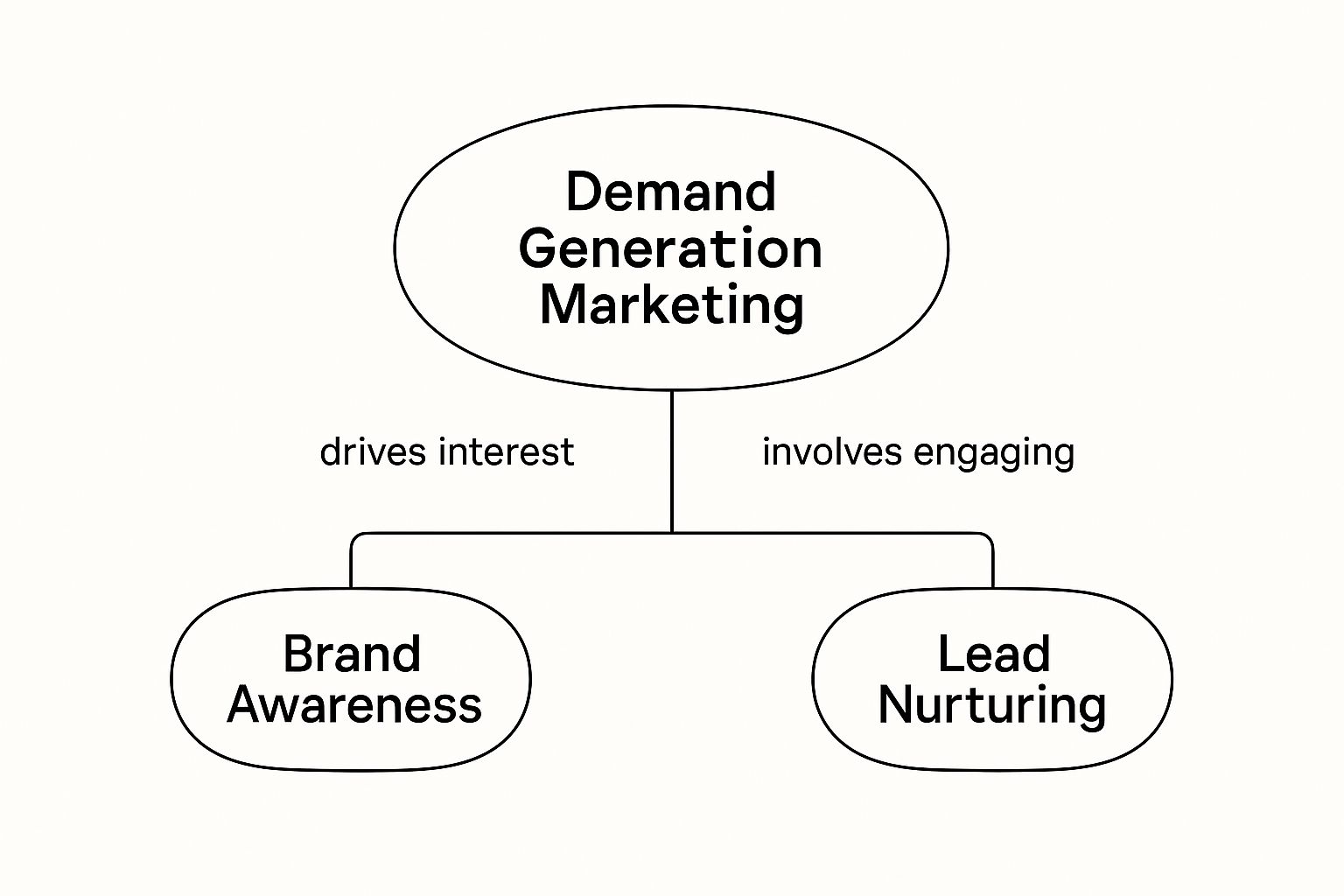
As you can see, these two functions aren’t separate activities. They are the core outcomes of a single, unified demand generation strategy.
Demand Generation vs. Lead Generation
People often use these terms interchangeably, but they serve very different purposes. Getting the distinction right is crucial for building a marketing engine that actually works.
Demand generation creates the “why”—why a prospect should even care about the problem you solve. Lead generation captures the “who”—the specific people interested enough to give you their contact information.
This handy table breaks down the key differences in a bit more detail.
Demand Generation vs Lead Generation At a Glance
| Aspect | Demand Generation | Lead Generation |
|---|---|---|
| Primary Goal | Educate the market and build brand authority. | Capture contact information from interested prospects. |
| Focus | Top-of-funnel awareness and interest. | Mid-to-bottom of the funnel conversion. |
| Tactics | Blog posts, webinars, podcasts, free tools, social media. | Gated content (eBooks), demo requests, free trials. |
| Success Metric | Audience growth, website traffic, engagement. | Cost per lead (CPL), conversion rates, MQLs. |
Simply put, you can’t have effective lead generation without first creating demand. One builds the audience, and the other converts that audience into tangible sales opportunities. They are two sides of the same coin.
The Core Components of a Demand Strategy

A powerful demand generation engine isn’t built on a single tactic. Think of it as a well-oiled machine where several crucial parts work together to create awareness, educate your audience, and build genuine interest.
Let’s stick with the machine analogy. You need fuel, a navigation system to point you in the right direction, and a way to get your message out on the open road. Each part has a specific job, but they only create real momentum when they work in sync. Let’s break down these essential elements.
Content Marketing: The Fuel for Your Engine
Content marketing is the absolute heart of any demand generation effort. This is where you create and share genuinely useful information that your ideal customers actually want to read, watch, or listen to. It’s not about constant sales pitches; it’s about being helpful.
The goal is to solve problems and answer your audience’s questions long before they’re even thinking about buying something. When you consistently deliver high-quality content, you position your brand as a trusted expert, building credibility that pays off down the road.
This content can come in many flavors, each suited for a different stage of the buyer’s journey:
- Blog Posts: These are your front door. They’re perfect for attracting a wide audience by tackling common pain points and industry trends, making that crucial first impression.
- eBooks and Whitepapers: These are the deep dives. They showcase your expertise on a specific topic and are great for engaging people who are ready to learn more.
- Webinars and Podcasts: Want to get personal? These interactive formats let you connect with your audience directly, often through expert interviews or detailed tutorials.
- Free Tools and Templates: These offer immediate, practical value. By solving a real-world problem for your user, you create a positive brand experience they won’t forget.
SEO: The Navigation System
Okay, so you’ve created some brilliant content. Now what? If people can’t find it, it might as well not exist. This is where Search Engine Optimization (SEO) becomes your best friend. SEO is all about fine-tuning your content so it shows up high in search engine results when people look for answers.
When a potential customer Googles a problem they’re facing, you want your solution to be one of the first things they see. A solid SEO strategy makes sure your helpful articles and guides are visible at the exact moment your audience needs them most.
SEO makes your valuable content discoverable, turning passive assets into active, traffic-driving machines. It connects the problems your audience is searching for with the solutions you provide.
For any B2B company, a smart SEO approach is non-negotiable for attracting high-quality traffic. By targeting the specific keywords your customers use, you pull in visitors who are already signaling their interest just by searching. This powerful partnership between content and SEO is the foundation of modern demand generation.
Social Media and Paid Advertising: The Distribution Channels
With great content that’s optimized for search, the final piece is getting it in front of people. Social media and paid advertising are the turbochargers that amplify your message and get it to the right audience, right now.
Platforms like LinkedIn are more than just a place to post company updates; they’re communities where you can build real relationships. Sharing your content, joining industry discussions, and running targeted campaigns helps you reach new people and solidify your brand’s authority.
Paid advertising, like pay-per-click (PPC) ads or sponsored social media posts, lets you get incredibly specific. You can target people based on their job title, industry, or online behavior, ensuring your best content lands directly in front of your ideal customers.
These components are distinct, but they’re also deeply connected. To see how these elements fit into a broader sales context, you can learn more about effective B2B SaaS lead generation strategies that build on a strong demand foundation. A winning strategy always weaves together insightful content, smart SEO, and targeted distribution to create a seamless journey from a person’s first Google search to them becoming a happy customer.
How to Measure Demand Generation Success
So, you’re creating some fantastic content and getting your name out there. That’s great, but how do you know if any of it is actually moving the needle? Measuring your demand generation strategy means looking beyond vanity metrics like social media likes and digging into the numbers that truly signal business impact.
Think of it this way: you wouldn’t navigate a ship just by looking at how fast the engine is spinning. You’d be checking your compass and mapping your progress to make sure you’re actually heading toward your destination. The right metrics are your navigation tools, telling you if your strategy is on course or drifting into open water.
Let’s break down the essential metrics that paint the full picture of your demand generation performance and prove its value.
Moving From Volume to Value Metrics
The first big shift in measurement is focusing on quality over quantity. Sure, a spike in website traffic looks good on a chart, but it’s a hollow victory if none of those visitors are the right fit for what you sell.
Success in demand generation isn’t just about attracting eyeballs; it’s about attracting the right eyeballs and influencing their journey. To do that, you need to connect your marketing activities directly to sales outcomes.
These are the core metrics that bridge that gap:
- Marketing Qualified Leads (MQLs): Think of an MQL as someone who has raised their hand with interest. They’ve downloaded an ebook, signed up for a webinar, or repeatedly visited your pricing page. This metric tells you how well your top-of-funnel content is resonating with your target audience.
- Sales Qualified Leads (SQLs): This is where the baton gets passed. An MQL becomes an SQL once the sales team reviews them and agrees they have real potential to become a customer. It’s a crucial gut-check on your lead quality and the alignment between marketing and sales.
- Pipeline Influence: This shows what percentage of the sales pipeline was touched by marketing. It’s a powerful way to demonstrate how your efforts contribute to revenue opportunities, even if they weren’t the very last click before a deal closed.
Calculating Your Return on Investment
At the end of the day, your efforts need to generate more value than they cost. This is where you put your money where your mouth is and use financial metrics to prove your impact.
The Customer Acquisition Cost (CAC) is arguably one of the most important figures to track. It calculates the total sales and marketing spend required to bring in one new customer. Your goal is to see this number decrease over time, proving your machine is getting more efficient. If you want to get into the nitty-gritty, you can explore the details of calculating SaaS customer acquisition cost and its nuances.
Another key number is your MQL-to-SQL Conversion Rate. This percentage reveals how many of your MQLs are actually deemed valuable enough for sales to pursue. A low rate here often points to a disconnect—marketing might be attracting an audience that sales doesn’t see as a good fit.
Tracking these conversion rates is like watching the handoff in a relay race. A smooth exchange keeps the momentum going, but a fumbled baton means you’re losing valuable opportunities between departments.
On average, businesses generate around 1,877 leads each month, with the average cost per lead sitting at roughly $198. But here’s the catch: with 44% of sales reps feeling too swamped to follow up effectively, the quality of those leads becomes everything. If you’re not sending over high-intent prospects, that investment is going to waste.
What’s Next for Demand Generation?
The world of demand generation never sits still. What got you great results last year might fall flat today. To stay ahead of the curve, you have to keep an eye on the trends that are actually changing the game, not just creating buzz.
Right now, two powerful forces are reshaping everything: the practical application of Artificial Intelligence (AI) and the laser-focused strategy of Account-Based Marketing (ABM). These aren’t just minor tweaks to the old playbook. They represent a real shift from wide-net campaigns to smarter, personalized engagement that works on a massive scale.
AI is Getting Smarter: Personalization and Prediction
Artificial intelligence has officially moved beyond the hype and is now a must-have tool in any modern demand generation strategy. The real magic of AI is its ability to chew through huge amounts of data to both personalize experiences and predict what someone will do next.
Instead of taking a wild guess at what content a prospect wants, AI looks at their digital breadcrumbs—every website visit, content download, and social media interaction. It then serves up the perfect message at just the right moment. One person might get a deep-dive technical whitepaper, while another sees a high-level industry report, and it all happens automatically.
Even better, AI is bringing some powerful predictive muscle to the table:
- Predictive Lead Scoring: AI models can sift through your past wins to figure out what your best customers look like. Then, they score new leads based on how well they fit that profile, so your sales team can stop chasing dead ends and focus on the leads most likely to close.
- Content Recommendations: By tracking user behavior, AI can suggest the next best piece of content for each person, creating a natural, self-guided journey that keeps them moving forward.
- Churn Prediction: AI is also great at spotting the subtle signs that a customer might be about to leave. This gives you a heads-up to step in with help or useful content before it’s too late.
With AI, marketers are finally shifting from reacting to customer behavior to anticipating their needs. It’s a complete game-changer, allowing us to build stronger relationships by being more relevant from the very first touchpoint.
Getting Strategic with Account-Based Marketing
While AI is fantastic for personalizing at scale, Account-Based Marketing (ABM) brings a different but equally powerful philosophy to the table: depth over breadth. Instead of trying to talk to everyone, ABM treats your most valuable target accounts as markets of one.
Think of it this way: traditional marketing is like throwing a giant conference and hoping the right people show up. ABM is like hosting an exclusive, VIP dinner where every detail is tailored to your handful of guests.
This super-targeted approach demands that your sales and marketing teams be in lockstep. They work together to handpick a list of dream accounts and then build custom campaigns designed to solve that specific company’s problems. That could mean anything from creating a bespoke landing page to hosting a private webinar just for their team.
The entire industry is moving in this direction. The most impactful demand generation trends are all about combining the scale of AI with the focus of ABM. These aren’t just passing fads; they are the most effective ways to improve lead quality and finally prove marketing’s direct contribution to the bottom line.
Real-World Examples of Great Demand Generation

Theory is great, but seeing how the pros do it is where the real learning happens. Some of the biggest names in B2B didn’t just build great products; they built masterful demand generation engines that pull in massive, loyal followings.
Let’s pull back the curtain on a few of these titans. We’re not just going to admire their success—we’ll break down the specific plays they’re running. These examples are packed with inspiring and practical ideas you can adapt for your own company, no matter your size.
HubSpot: The Content Education Machine
When it comes to using content to generate demand, HubSpot is the undisputed champion. Instead of constantly talking about their software, they focus on teaching you how to be a better marketer, salesperson, or business owner. Their entire playbook is built on giving away incredible value for free, earning trust long before anyone even thinks about buying their product.
Their approach is simple but incredibly powerful: become the go-to educational resource for their ideal customer. They’ve absolutely nailed this with a few key pillars.
- HubSpot Academy: This isn’t just a blog with a fancy name. It’s a full-blown learning platform with free courses and certifications on everything from content marketing to sales management. It builds real expertise and goodwill on a massive scale.
- A Powerhouse Blog: The HubSpot blog is an absolute beast, pulling in millions of visitors every month. They do it by answering just about any question a marketer could possibly have, making them a textbook example of SEO-driven content that captures attention at the very top of the funnel.
- Free Tools That Actually Help: Things like the Website Grader or Make My Persona solve a real, immediate problem for a user. This gives people a positive, helpful interaction with the brand and gently introduces them to the HubSpot ecosystem without any hard-selling.
By putting education ahead of promotion, HubSpot makes sure that when their audience is finally ready to buy marketing software, they’re the first and most trusted name that pops into their heads.
HubSpot’s strategy proves a fundamental truth of modern marketing: the best way to sell something is to stop selling. Instead, teach, help, and empower your audience to succeed.
Salesforce: The Community and Event Powerhouse
While HubSpot built its empire on content, Salesforce took a different path that’s just as effective: they built an unstoppable community and centered their marketing around epic events. Their flagship conference, Dreamforce, is the ultimate example of turning demand generation into a full-blown experience.
Dreamforce isn’t your typical tech conference; it’s a massive, multi-day festival that brings customers, partners, and industry leaders together. It creates an incredible sense of belonging and excitement around the Salesforce brand. The event itself becomes the gravitational center of their marketing calendar, spinning off a year’s worth of content, announcements, and buzz.
But their community-building goes way beyond one huge event.
- Trailblazer Community: This online hub connects millions of users, letting them ask questions, share tips, and help each other out. It effectively turns customers into passionate advocates and even eases the support load on Salesforce’s own team.
- Local User Groups: Salesforce actively encourages and supports local user groups all over the world. These meetups create valuable peer-to-peer connections and strengthen the brand’s presence at a grassroots level.
Through these efforts, Salesforce has created a powerful network effect. The more people who join their community, the more valuable it becomes for everyone involved. This community is a self-fueling engine for demand, driving fierce loyalty and attracting new customers who want to be part of something bigger.
Adobe: The Creative Authority
Adobe’s demand generation strategy is all about owning the entire conversation around creativity and digital experiences. They don’t just sell creative software; they inspire the creative process itself, positioning themselves as an essential partner for designers, marketers, and artists everywhere.
Their playbook is focused on showing people what’s possible with their tools and empowering their community to push the boundaries of creativity. They do this with a few key tactics.
- Adobe MAX: Just like Dreamforce, MAX is a cornerstone event that gathers the entire creative community for inspiration and learning. It’s where they reveal exciting product updates and feature top-tier artists, constantly reinforcing their status as the industry leader.
- Behance: By acquiring and growing Behance, the world’s leading online portfolio platform, Adobe brilliantly embedded itself into the daily lives of millions of creatives. It’s a genius move that provides huge value to the community while keeping the Adobe brand top-of-mind.
Adobe gets it. Their audience isn’t just looking for tools; they’re looking for a spark of inspiration. By providing that spark, Adobe creates unshakeable brand loyalty and generates demand organically, from the ground up.
Common Questions About Demand Generation
Even after getting a handle on the basics, some practical questions always seem to pop up when teams first dip their toes into demand generation. It’s a pretty big shift from the old way of doing marketing, so it’s completely normal to have a few things you’re still trying to sort out.
Let’s clear up some of the most common ones. Here are a few straight answers to help you connect the dots and move forward with confidence.
What Is the Difference Between Demand Generation and Inbound Marketing?
This is easily the most frequent question, and the answer really comes down to scope.
Think of demand generation as the entire orchestra—it’s the big-picture strategy that pulls together every marketing activity to create awareness and genuine interest in what you offer.
Inbound marketing, on the other hand, is like the string section. It’s a critical, beautiful part of the performance, but it isn’t the whole performance.
Demand generation uses a mix of tactics—both inbound (like SEO and content) and outbound (like targeted ads or events). Inbound marketing focuses only on attracting customers with valuable content they’re already looking for.
Here’s a simpler way to look at it:
- Demand Generation (The Orchestra): Uses everything in its toolbox, both inbound and outbound. The main goal is to create an entire market for a solution by educating prospects and building brand authority.
- Inbound Marketing (The Strings Section): Sticks to “pull” tactics like blogging, SEO, and social media to draw an audience in organically.
In short, inbound is a key ingredient in any modern demand generation strategy, but demand generation is the much bigger recipe.
How Do You Build a Demand Generation Strategy From Scratch?
Building a whole strategy from a blank page can feel like a massive task, but it’s much more manageable if you break it down into logical steps. You don’t have to boil the ocean here. Just start with a solid foundation and build up from there.
Any good strategy starts with two things: knowing your customer inside and out, and setting clear goals. The secret is to start small, test what you’re doing, and then pour resources into what actually works.
Here’s a simple roadmap to get you going:
- Define Your Ideal Customer Profile (ICP): Before you do anything else, you need a razor-sharp picture of who you’re talking to. What are their biggest headaches? Where do they go for information online?
- Set Specific, Measurable Goals: Vague goals like “get more awareness” are useless. You need something concrete, like “increase Marketing Qualified Leads by 20% this quarter” or “grow organic blog traffic by 30% in the next six months.”
- Map the Customer Journey: Think through the different stages a person goes through, from vaguely hearing about you to actually buying. Plan out what content and channels you’ll use to meet them at each step.
- Choose Your Tactical Mix: You don’t need to be everywhere at once. Start with a balanced mix of proven tactics—maybe some content marketing, SEO, email nurturing, and a couple of highly targeted ad campaigns. For more great ideas, our guide to B2B SaaS marketing strategies is packed with actionable advice.
- Establish Your Tracking and Metrics: Get your analytics set up from day one. You can’t improve what you don’t measure, so make sure you can see what’s working and what’s a waste of money.
- Get Tight with Sales: Your demand generation efforts are dead in the water without a strong partnership with the sales team. Work together to define what a “good lead” looks like and create a seamless handoff process.
Is Demand Generation Only for B2B Companies?
Not at all. While demand generation is the bread and butter of B2B marketing—mostly because of the long, complex sales cycles—its principles work wonders for plenty of B2C companies, too.
The core idea of educating an audience and nurturing interest works any time a customer isn’t making a quick impulse buy. Think about any “considered purchase” in the B2C world, where people have to do some research before pulling out their wallets.
This is where demand generation can be a game-changer for B2C brands in areas like:
- Automotive: Car companies are masters at this. They use video reviews, comparison guides, and online forums to build excitement and guide people through the research process.
- Higher Education: Universities create demand with webinars, virtual campus tours, and helpful guides on career paths to attract prospective students long before they apply.
- Financial Services: Banks and investment firms use blogs, podcasts, and free financial planning tools to build trust and position themselves as authorities.
Any time a purchase involves a serious investment of time or money, demand generation has a role to play. B2C brands can use tactics like influencer marketing, how-to videos, and online communities to build a loyal following and drive long-term demand.
The strategy is always the same: educate first, sell second.