
Telling your sales team to "increase sales" is a bit like telling a ship's captain to just "sail somewhere." It’s full of good intention, but it offers zero direction. For sales goals to actually work, they need structure and clarity, and that's exactly what the SMART framework brings to the table. It's a method for turning fuzzy ambitions into real, actionable targets that can actually guide your team to a win.
Why Vague Sales Targets Fail and SMART Goals Win

Think of your sales team as the crew of that ship. A vague goal like "grow revenue" leaves them adrift in the open ocean without a map, a compass, or even a destination. They might row with all their might, but their efforts are scattered and ultimately wasted because they don't have a clear objective. This kind of ambiguity almost always leads to confusion, misused resources, and a demoralized team that feels like it’s just spinning its wheels.
This is where setting SMART goals for sales gives you a serious edge. The framework is your team’s navigation system, providing the precise coordinates they need to get where they're going. It turns wishful thinking into a concrete plan of action.
The Power of a Clear Destination
When you don’t have a defined target, it’s impossible to measure progress or celebrate milestones along the way. How can you possibly know if you're on track to "sell more" if you never decided what "more" actually looks like? This lack of clarity is what creates the huge performance gap between teams running on ambition alone and those executing a real strategy.
A structured approach makes sure everyone on the team understands the destination and the route to get there. This alignment builds a culture of accountability and shared purpose. Some of the biggest benefits are:
- Improved Team Focus: Everyone knows exactly what they’re aiming for, which cuts out the wasted effort on low-impact activities.
- Enhanced Motivation: Clear, achievable milestones keep the team engaged and give them regular opportunities to celebrate small wins.
- Accurate Performance Tracking: You can actually monitor progress with real data, which lets you make adjustments and provide coaching when it matters most.
- Better Strategic Alignment: Each salesperson's goals connect directly to the bigger company objectives, giving their daily work a real sense of meaning.
Vague goals produce vague results. The specificity of the SMART framework forces sales leaders to think critically about what they truly want to achieve and how they plan to get there, turning hope into a reliable strategy.
From Ambition to Actionable Strategy
In the end, the difference is pretty simple. Vague goals are just passive wishes, but SMART goals are active commitments. They force you to create a plan for how you'll hit the target, making success a matter of solid execution, not just good luck. This framework isn't about creating more administrative busywork; it's the blueprint for building a high-performance sales engine that consistently hits its numbers.
Breaking Down the SMART Framework for Sales
If you want to turn wishy-washy ideas into real results, you need a solid system. For sales teams, that system is the SMART framework. It’s a simple but powerful acronym that provides the structure you need to get from a fuzzy objective to an actionable plan that actually drives performance.
Think of each letter as a filter. By the time your goal passes through all five, it’s lean, clear, and built for success.
Let's walk through this with a real-world scenario. Imagine a software company, "Innovate Solutions," wants to crack into the healthcare market. Their starting goal is just to "get more clients." It’s a nice thought, but it’s too vague to get anyone moving in the right direction.
By applying the SMART framework, we can sharpen this ambition into a target their sales team can actually hit. This isn't just busywork; sales teams with clearly defined goals have been shown to outperform those with vague ones by an impressive 43%. For more on how specific goals fuel success, you can find some great examples and tips for 2025 on InvestGlass.com.
S is for Specific
First things first, you have to kill the ambiguity. A specific goal clearly answers the classic "W" questions: Who? What? Where? When? Why? Instead of just wanting more clients, Innovate Solutions needs to paint a much clearer picture.
A specific version of their goal sounds more like this: "Acquire 10 new mid-market clients in the U.S. healthcare sector." Right away, everyone knows who we're after (mid-market healthcare companies), what we need to do (land 10 new clients), and where our efforts are focused (the U.S.).
M is for Measurable
If you can't measure it, you can't manage it. Simple as that. This step forces you to define what success looks like in cold, hard numbers. It’s the difference between feeling like you’re "doing well" and knowing for a fact that you’ve hit your target.
For Innovate Solutions, the goal is already measurable: 10 new clients. That number is the finish line. Every signed contract moves the needle in their CRM, giving the whole team a transparent scoreboard to rally around.
This image breaks down how a big annual number becomes much less intimidating when you slice it into monthly and weekly targets.
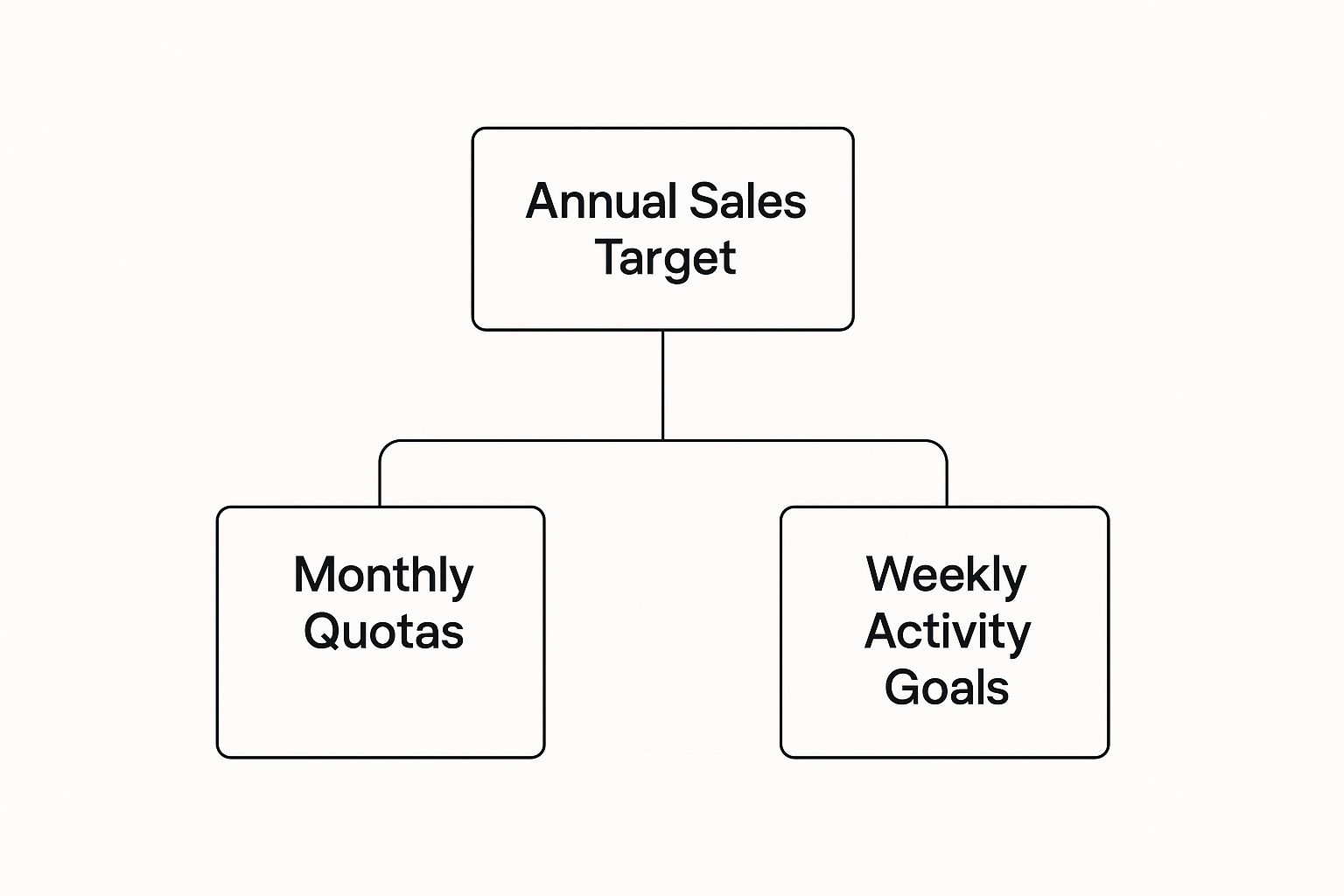
As you can see, massive goals feel much more manageable when you break them down into smaller, trackable steps.
A is for Achievable
A goal needs to hit that sweet spot between ambition and reality. It should be challenging enough to get people fired up, but not so out of reach that it kills morale before you even start. To find that balance, you have to look at your history, your team's capacity, and what’s happening in the market.
The sales leaders at Innovate Solutions should be asking themselves:
- How many new clients did we land last quarter in a similar market?
- What's our current lead flow and conversion rate looking like for healthcare?
- Does the team honestly have the bandwidth to chase 10 new clients right now?
If they usually close five deals a quarter, then shooting for 10 is a solid stretch goal—tough, but doable. Aiming for 50, on the other hand, would probably just make the team roll their eyes and disengage.
An achievable goal stretches your team's capabilities without breaking their spirit. It fosters a sense of momentum and builds confidence with every milestone reached.
R is for Relevant
A goal is only worth chasing if it actually matters. The "Relevant" check is about making sure the objective lines up with the bigger picture—the department's mission and the company's overall strategy. Every sales goal should be a puzzle piece that fits into a larger vision.
For Innovate Solutions, targeting the healthcare sector is highly relevant. It directly supports the company's strategic push to expand into a lucrative new industry. That connection gives the sales team's daily grind a real sense of purpose. They aren't just closing deals; they're pioneers for the company's future.
T is for Time-Bound
And finally, every goal needs a deadline. Putting a date on it creates a natural sense of urgency and stops good intentions from getting kicked down the road forever. Without a finish line, there’s no reason to start sprinting.
Innovate Solutions just needs to add that timeframe. Their final, fully-formed goal becomes: "Acquire 10 new mid-market clients in the U.S. healthcare sector by the end of Q3." Now there’s a clear deadline, which lets the sales manager build a weekly and monthly game plan to keep everyone on track.
The table below shows a few more examples of how you can transform those common, fuzzy sales ambitions into powerful SMART goals that your team can get behind.
From Vague Sales Ambitions to Actionable SMART Goals
| Vague Goal | SMART Goal Breakdown |
|---|---|
| "Increase revenue this year." | S: Increase revenue from our new enterprise software product. M: Achieve a 20% increase in monthly recurring revenue. A: Based on last quarter's 12% growth and a new marketing campaign, 20% is a challenging but achievable target. R: This directly supports the company's strategic focus on upselling our enterprise-level offerings. T: Achieve this by the end of the fiscal year. |
| "Get more leads for the sales team." | S: Generate qualified leads through hosting webinars. M: Generate 150 new Marketing Qualified Leads (MQLs). A: Our last webinar generated 110 MQLs, and with a larger promotional budget, we can realistically aim for 150. R: More MQLs will fill the top of the sales funnel, which is a key departmental objective. T: Generate these leads from our upcoming webinar on June 15th. |
| "Improve our sales process." | S: Reduce the average sales cycle length for mid-market deals. M: Shorten the cycle from 60 days to 45 days. A: We've identified bottlenecks in the demo and proposal stages that can be streamlined with new software. R: A shorter sales cycle means faster revenue recognition and a more efficient sales team. T: Implement the changes and achieve the 45-day average by the end of Q4. |
Turning vague statements into a SMART framework doesn't just add clarity; it gives your team a roadmap. They know exactly where they're going, how they'll get there, and what success looks like when they arrive.
Keeping Your Sales Team From Burning Out with Goals They Can Actually Hit

While every part of the SMART framework matters, let's talk about the two that really guard your team's sanity and motivation: Achievable and Relevant. If you get these wrong, even the most well-defined, measurable goal will just fall flat. Think of them as your secret weapons against burnout.
Setting an impossible target is like telling a runner to sprint an entire marathon. It’s a spirit-crusher before they even take the first step. The psychology is simple: when people feel a goal is completely out of reach, they'll stop trying. This is the fastest way to burn out your best people and watch productivity tank.
Setting Goals That Stretch, Not Break
The trick with the 'Achievable' part is finding that sweet spot between a comfortable jog and an impossible climb. You want a goal that pushes your team to get better, to innovate, but not one that feels so far-fetched it demolishes their confidence. This isn't about plucking a number out of thin air; it’s a strategic move based on real data.
To make sure your goals are genuinely achievable, you have to look at a few things:
- Past Performance: What do the numbers from previous quarters or years tell you? What was the average growth? What did your top reps hit? This gives you a realistic starting point.
- Your Team's Current State: Do you have new hires still getting up to speed? Did a top performer just leave? Be honest about your team's skills and capacity right now.
- What's Happening in the Market: Is your industry booming or slowing down? Are new competitors making things tough? You can't set goals in a vacuum; external factors are a huge piece of the puzzle.
A great example of an achievable goal is aiming for a $1 million revenue increase when you hit $700,000 last year. That's a stretch, but it's doable. Jumping to $5 million? That's just a recipe for crushed morale. The team over at Highspot.com has some fantastic insights on this.
The Power of "Why": Connecting Goals to the Bigger Picture
This brings us to 'Relevant,' which is all about giving the daily grind a purpose. A sales goal is relevant when it clearly ties back to what the department and the entire company are trying to accomplish. It answers that one critical question everyone on your team is asking: "Why am I doing this?"
When a salesperson sees exactly how their individual target helps the company break into a new market or launch a new product, their work suddenly means more. It's not just about a number anymore; it's about being part of a bigger story.
A relevant goal transforms a job into a mission. It shifts the focus from just hitting a quota to actively building a shared vision—and that’s a powerful motivator.
This connection is absolutely vital for keeping people engaged. When goals are relevant, team members can better prioritize what they work on, focusing on the activities that will actually move the needle for the whole company. For example, sharpening skills on how to qualify leads becomes a lot more meaningful when the team knows it directly supports the company's objective to reduce customer churn.
Building a Team That Lasts
At the end of the day, making your smart goals for sales both achievable and relevant is about playing the long game. It's how you build a culture of high performance that can last, instead of just a series of frantic sprints that lead straight to burnout.
By setting goals that are challenging but realistic, you create a powerful cycle of positive reinforcement. Every win, big or small, builds confidence and creates momentum, inspiring your team to aim a little higher the next time.
And when those wins are connected to a purpose they truly believe in? You unlock a level of commitment that no commission check alone can buy. That's how you keep your best people, build a truly collaborative team, and create a sales engine that just keeps on delivering, quarter after quarter.
SMART Sales Goal Examples You Can Actually Use
Theory is great, but seeing how SMART goals work in the real world is what really makes the concept click. Let's move past the textbook definitions and get into some practical, ready-to-use examples for your sales team.
We’ll look at goals for individual Account Executives, your front-line Sales Development Reps, and even Sales Managers. Each one is a blueprint showing how the five SMART criteria come together to create an objective that’s both ambitious and actionable.
Example for an Individual Sales Representative
For a sales rep, the best goals are tied directly to performance metrics they can control, like deal size, close rates, or revenue. You want to zero in on a specific behavior that drives a bigger outcome.
Goal: Increase average deal size by 15% in Q3 by consistently bundling the premium support package with all enterprise-level software proposals.
Let's break this down:
- Specific: It’s not just "sell more." It’s about increasing the average deal size by using a specific tactic—bundling a premium package with a certain type of deal. Crystal clear.
- Measurable: A 15% increase is a hard number. You can pull a report in your CRM at the end of Q3 and know instantly if you hit the mark.
- Achievable: A 15% bump is a solid stretch, but it's not a pipe dream. It’s grounded in a real strategy, not just wishful thinking.
- Relevant: This goal feeds directly into the company’s bottom line. Bigger deals mean more revenue and better profitability per customer.
- Time-bound: There's a clear finish line: the end of Q3. This adds a healthy dose of urgency.
Example for a Sales Development Representative
SDRs are the lifeblood of the sales pipeline. Their goals should be all about activity and creating quality opportunities for the closers.
Goal: Schedule 35 qualified demos with VPs of Marketing at mid-market tech companies (50-500 employees) over the next 60 days.
Here’s why this works so well:
- Specific: It defines the exact task (schedule demos), the target audience (VPs of Marketing), and the right company fit (mid-market tech). No room for confusion.
- Measurable: The target is a concrete number: 35. Every booked demo is a clear step forward.
- Achievable: With a good lead list and the right tools, hitting four or five demos a week is challenging, but definitely within reach for a focused SDR.
- Relevant: This goal is a perfect hand-off. It directly fuels the B2B SaaS sales funnel and gives Account Executives the at-bats they need to hit their own numbers.
- Time-bound: The 60-day window sets a clear pace and provides a fixed timeframe for measuring success.
Example for a Sales Manager
A manager’s goals need to be bigger than one person's quota. They should focus on elevating the entire team's performance and making their processes more efficient.
Goal: Improve the team's lead-to-close conversion ratio from 10% to 13% by the end of the fiscal year by implementing a new weekly coaching program focused on objection handling.
A manager's real job isn't just to hit a number; it's to build a system that makes hitting future numbers a repeatable process. Focusing on a metric like conversion rate does exactly that.
Let’s look at this goal through the SMART lens:
- Specific: It isolates a crucial metric—the lead-to-close ratio—and names the exact strategy for improving it: a new coaching program on handling objections.
- Measurable: The goal is to get from 10% to 13%. That three-point jump is a quantifiable benchmark for the program's success.
- Achievable: A 3% improvement over a year is realistic, especially with consistent coaching. It recognizes that building skills takes time and effort.
- Relevant: A better conversion rate is pure gold. It means the team gets more revenue from the exact same number of leads, which is a massive win for efficiency.
- Time-bound: The end-of-year deadline gives the manager plenty of runway to roll out the coaching, let it sink in, and measure the results.
Research and practice show that setting a quarterly revenue growth goal of around 15% is a common and effective target for many sales teams. This is often supported by smaller goals, like landing 20 new logos or shrinking the sales cycle. For more ideas and examples, you can also check out resources like Tability.io.
Think of these examples as a starting point. Feel free to swap out the metrics, adjust the timelines, and tailor the strategies to fit your team’s specific needs and your company's bigger picture.
Using Technology to Track and Manage Sales Goals

Crafting the perfect SMART goals for sales is a huge step, but let's be honest: a goal without a tracking system is really just a wish. To turn those well-laid plans into actual results, you need technology to be your scoreboard, your compass, and your communication hub—all in one.
This is where your Customer Relationship Management (CRM) system steps up to the plate. Tools like Salesforce or HubSpot are so much more than digital address books. They are powerful engines for seeing exactly how you're tracking against your goals in real-time.
Building Your Mission Control Dashboard
Think of your CRM dashboard as the mission control for your sales operation. It’s the one place you can go for an instant, at-a-glance view of every key metric that matters. A well-designed dashboard cuts through the noise and tells you exactly where your team stands, right now.
Setting this up is easier than you might think. The trick is to create widgets or reports that directly mirror the 'Measurable' part of your SMART goals.
Your dashboard should give you a clear view of:
- Progress Bars for Quotas: Nothing beats a visual for showing how close individual reps and the entire team are to hitting their revenue or unit targets.
- Activity Metrics: Keep an eye on the leading indicators. How many calls were made? How many demos were scheduled? These are the inputs that drive your final outcomes.
- Conversion Rate Funnels: See how leads are actually moving through your pipeline. This quickly shows you where things are flowing smoothly and where deals might be getting stuck.
A transparent dashboard builds a culture of accountability and even some healthy competition. When everyone can see the score, it keeps them in the game and makes it obvious where a little extra effort is needed.
Automating Reports for Effortless Alignment
Nobody has time to manually pull numbers and build spreadsheets every week. That’s a massive time-sink and an open invitation for errors. Automation is a sales manager’s best friend here.
Most modern CRMs let you schedule and automatically send key reports to your team. You could set up a daily email summarizing new leads or a weekly report that gives a shout-out to top performers. This steady flow of information keeps goals front and center for everyone, without adding to your own to-do list.
For teams looking to take this even further, learning how to automate the sales process can be a complete game-changer, freeing up reps to do what they do best: sell.
The Power of a Consistent Review Cadence
Technology gives you the data, but it’s the human conversations that turn that data into action. A consistent rhythm for reviewing progress is what keeps the momentum going and helps you tackle problems before they grow. This isn't about micromanaging; it's about providing support and making smart adjustments along the way.
A solid review cadence usually includes:
- Weekly Team Huddles: These are quick, 15-30 minute check-ins focused on the week ahead. Look at the dashboard together, celebrate wins, and talk through any roadblocks people are hitting.
- Monthly Strategy Sessions: Zoom out and take a bigger-picture look at your performance against your quarterly SMART goals. Use this time to spot trends, share what's working, and tweak your strategy based on what the data is telling you.
This regular cycle of check-ins does more than just track numbers. It creates a supportive environment where reps feel comfortable asking for help and managers have clear opportunities to offer coaching that makes a difference. When you combine powerful CRM tools with a disciplined review process, you ensure your SMART goals aren't just written down—they're actively managed and, ultimately, achieved.
Common Pitfalls When Setting Sales Goals (And How to Dodge Them)
Even the best frameworks can go wrong in practice, and SMART goals are no exception. Knowing the common tripwires is just as important as knowing the rules. If you can sidestep these mistakes, your goals will actually drive performance instead of just creating more paperwork.
Let's start with a classic blunder: setting way too many goals. Picture this: you tell a sales rep to increase their average deal size, shorten their sales cycle, and break into a brand new market—all in the same quarter. That’s not a plan; it’s a recipe for burnout. The rep will be stretched so thin that they won't make meaningful progress on any of it.
When it comes to goals, think clarity, not complexity. One laser-focused objective will always beat five scattered priorities.
Instead of burying your team in a mountain of targets, figure out the one or two metrics that truly move the needle. If profitability is the company's top priority right now, a goal focused squarely on increasing average deal size is a much smarter play.
Forgetting to Involve Your Team
Another huge mistake is creating goals in an ivory tower and just handing them down. When salespeople have zero say in the targets they're supposed to hit, they don't feel any real ownership. You end up with reps who are just going through the motions instead of being genuinely driven to succeed.
The fix is simple: make goal-setting a team sport. Sit down with your reps and have a real conversation about the targets. Ask them what they think is ambitious but still within reach. This little act of collaboration makes them feel like partners in the business, not just names on a spreadsheet.
This approach is powerful for two reasons:
- It keeps goals realistic: Your frontline reps know the market and their customers better than anyone. Their feedback is invaluable.
- It builds accountability: People are far more invested in hitting a target they had a hand in creating.
The "Set It and Forget It" Trap
Finally, don't treat your goals like a time capsule you bury at the beginning of the quarter and dig up at the end. The business landscape changes far too quickly for that. A perfectly good goal in January could be completely irrelevant by March.
Market conditions can shift, a new competitor might pop up, or your own company's priorities could pivot. To stay ahead, you need to check in on your goals regularly. Use weekly team meetings to track progress, talk about what's getting in the way, and make small course corrections. This keeps your goals relevant and your team on a path to actually achieving them.
Frequently Asked Questions
Even the best plans run into real-world questions. Let's tackle some of the most common things sales leaders ask when they start putting SMART goals into practice.
How Often Should We Review Our Sales Goals?
There’s no single right answer here—it all comes down to the timeline of your goal. Think of it like a road trip. For a cross-country drive, you'll check the map at major junctions, but for navigating a city, you're looking at it block-by-block.
For those big, annual goals, you’ll want to sit down for a formal review every quarter, with monthly check-ins to make sure you’re still on the right highway. For shorter, quarterly goals, a quick weekly huddle is perfect. It keeps the goal top of mind and lets you clear out any small roadblocks before they become major traffic jams.
The most important thing is consistency. Regular check-ins keep goals from being forgotten and give you the chance to pivot if the market throws you a curveball.
What’s The Difference Between a Sales KPI and a SMART Goal?
This is a classic question, and it's easy to get them mixed up. The simplest way to think about it is that a KPI (Key Performance Indicator) is a metric you’re always watching, while a SMART goal is the specific destination you want to reach with that metric.
Imagine you're driving. Your speedometer shows your speed—that's your KPI. Your goal to "get from New York to Boston in under four hours" is your SMART goal. You use the KPI to measure your progress toward the goal.
Here’s how it looks in a sales context:
- KPI: Customer retention rate.
- SMART Goal: Increase our customer retention rate from 85% to 90% by the end of Q4.
So, KPIs measure the how, and SMART goals define the what and when.
How Do You Set Goals for a New Product or Team?
This is tough. Setting goals without any past data can feel like you're just throwing a dart in the dark, especially when trying to make them Achievable. The trick is to start small and think of your first month or two as an intelligence-gathering mission.
Set a few short-term goals for the first 30 or 60 days. Base these initial targets on what you can find—market research, what your competitors are doing, or any industry benchmarks you can get your hands on.
The key is to treat these first goals as a baseline, not a promise set in stone. Be ready to adjust them once you have your own real-world data coming in. The objective isn't to be perfect on day one; it's to establish a starting point you can build on.