Think of SaaS Customer Acquisition Cost (CAC) as the price tag on winning a new customer. It’s the total amount you spend on your sales and marketing efforts just to get one new person to sign up and pay for your service. Getting a handle on this number is the first real step toward building a business that can actually grow and make money.
What Is SaaS Customer Acquisition Cost Anyway?
Let’s use an analogy. Say you run a great local coffee shop. To get a new regular, you wouldn’t just count the cost of a single newspaper ad. You’d have to think bigger. You’d factor in the free samples you gave out, a slice of your friendly barista’s salary, and even the cost of those premium beans you used to make that first unforgettable cup. All those little things add up to win that one person’s loyalty.
It’s the exact same idea for your SaaS business. Your SaaS customer acquisition cost is way more than just what you spend on Google or LinkedIn ads. It’s what we call a “fully loaded” metric, meaning it needs to include every single dollar you put into your go-to-market machine.
The True Cost of a New Customer
To get a real, honest number, your CAC has to cover all the related expenses over a set period. This means adding up costs that are easy to forget but are absolutely part of the customer-winning process. A truly complete picture includes:
- Marketing Team Salaries: The paychecks for everyone creating campaigns and bringing in leads.
- Sales Team Salaries and Commissions: The cost of the folks who are actually closing the deals.
- Advertising Spend: Every penny spent on paid channels—social media ads, search engine marketing, you name it.
- Tools and Software: The subscriptions for your CRM, marketing automation platforms like HubSpot, analytics tools, and all the other tech you rely on.
- Content Creation Costs: The money it takes to produce blog posts, videos, and webinars that attract and educate potential customers.
Why This Metric Is Non-Negotiable
You have to start seeing your SaaS customer acquisition cost as a strategic investment, not just another line item expense. It’s a direct reflection of how efficient and scalable your business is. If you don’t have a firm grip on your CAC, you’re flying blind. You can’t make smart decisions about your budget, your pricing, or your overall growth plan.
A low CAC isn’t always the goal; a profitable CAC is. The key is finding the right balance between what you spend to acquire a customer and the long-term revenue that customer will generate.
This balance is everything. For example, in 2025, it’s not uncommon for SaaS companies to see their CAC range from $200 to over $700. That number really depends on the industry and how complex the sales process is. Companies with higher costs usually have longer sales cycles that require a lot more educational content and one-on-one attention.
If you’re curious, you can find more insights about SaaS CAC benchmarks to see how you stack up. At the end of the day, knowing this number gives you the power to build a growth engine that can last.
How to Actually Calculate Your SaaS CAC
Figuring out your SaaS customer acquisition cost can feel like a chore, but it’s one of the most honest numbers in your business. It tells you exactly what you’re spending to bring a new customer through the door, and it’s the first step to making smarter decisions about where your money goes.
The formula itself is refreshingly simple:
Total Sales & Marketing Spend ÷ Number of New Customers = Customer Acquisition Cost (CAC)
Easy, right? But the real work—and where most people trip up—is in tallying up those “total costs.” A lot of founders accidentally leave things out, which gives them a CAC that looks great on a slide deck but doesn’t reflect reality.
What Goes Into “Total Sales & Marketing Spend”?
To get a true, “fully loaded” CAC, you need to track every dollar you spent to win new business over a specific time, whether that’s a month or a quarter. Think of it like a recipe. If you forget a key ingredient, the whole thing will be off.
Here’s a quick checklist of what to include:
- Salaries and Commissions: This is the big one. You have to include the base salaries for your entire sales and marketing teams, plus every dollar paid out in commissions and bonuses. It’s usually the largest expense, and it’s the one most often overlooked.
- Ad Spend: Tally up what you spent on Google Ads, LinkedIn campaigns, social media promotions, sponsorships—all of it.
- Creative & Content Costs: Did you hire a freelance writer for your blog? Pay a designer for new graphics or a video editor for a product demo? Those costs count.
- Software & Tools: Add up the subscription fees for your CRM, marketing automation platform, analytics software, and any other tool your teams use to attract and close deals.
When you add everything up, you get a number that’s real. Only then can you trust the CAC metric to guide your financial planning.
A Quick Calculation Example
Let’s walk through an example. Imagine a SaaS startup called “ConnectSphere” is calculating its CAC for Q3.
Here’s what they spent:
- Sales & Marketing Salaries: $90,000
- Sales Commissions: $15,000
- Paid Ad Spend: $25,000
- Content Creation (Freelancers): $5,000
- Marketing & Sales Software: $5,000
First, we’ll get their total spend by adding it all together.
$90,000 (Salaries) + $15,000 (Commissions) + $25,000 (Ads) + $5,000 (Content) + $5,000 (Software) = $140,000 in Total Costs
During that same quarter, the ConnectSphere team brought in 100 new paying customers.
Now, we just plug those numbers into the formula:
$140,000 (Total Costs) ÷ 100 (New Customers) = $1,400 (CAC)
ConnectSphere’s fully loaded CAC for the third quarter was $1,400. That means, on average, it cost them fourteen hundred bucks to sign up each new customer. Knowing this number is critical for planning their future B2B SaaS lead generation efforts.
Common Pitfalls to Sidestep
The CAC formula looks straightforward, but a few common mistakes can throw your numbers way off.
- Forgetting to Go “Fully Loaded”: The number one mistake is leaving out salaries. Your people are your biggest investment in growth. If you don’t include their cost, you’re getting a dangerously optimistic CAC that isn’t true.
- Mismatched Time Frames: You have to be consistent. If you’re using marketing spend from Q3, you can only count the new customers you won in Q3. Don’t mix and match, or your calculation will be worthless.
- Mixing in Retention Costs: CAC is all about new customers. Any money you spend on keeping your existing customers happy or upselling them belongs in a different bucket. Don’t let those costs sneak into your acquisition math.
Avoid these traps, and you’ll have a CAC figure you can truly rely on—a powerful tool for steering your company toward profitable growth.
Connecting CAC to Your Business Health
Knowing your SaaS customer acquisition cost is a lot like checking your car’s gas mileage. It’s a vital number, sure, but it doesn’t tell you if you’re actually winning the race. The real magic happens when you connect CAC to other key business metrics.
That’s when CAC goes from being a simple line item on an expense report to a powerful diagnostic tool for your entire business. By comparing it to the value a customer brings in over their lifetime, you get a crystal-clear picture of your company’s long-term health. Without that context, you’re just staring at a number in a vacuum.
The LTV to CAC Ratio: Your Ultimate Health Gauge
In the world of SaaS, no relationship is more important than the one between Customer Lifetime Value (LTV) and Customer Acquisition Cost. LTV is the total revenue you can reasonably expect to get from a single customer over their entire time with you.
Think about it this way: CAC is what you pay to get a customer through the door. LTV is all the money they spend once they’re inside. The goal is simple—you need the money they bring in to be much greater than what it cost you to get them there.
This crucial comparison is captured in a simple but mighty ratio.
LTV ÷ CAC = LTV:CAC Ratio
This one number tells you exactly how much return you’re getting from your sales and marketing efforts. It’s the ultimate health check for a subscription business, showing whether your growth is actually profitable or just plain expensive.
So, what’s a good ratio to shoot for?
- A 1:1 ratio is a red flag. You’re essentially losing money on every new customer, since this doesn’t even account for the cost of servicing their account.
- A ratio below 3:1 suggests your business model might be on shaky ground. You’re likely spending too much for what each customer is worth over time.
- A 3:1 ratio is the gold standard. This is the sweet spot that signals a healthy, profitable, and scalable business. For every dollar you spend on acquisition, you’re making three dollars back.
- A ratio of 5:1 or higher is fantastic, but it might also hint that you’re underinvesting in growth. You could be missing a huge opportunity to acquire even more customers by turning up your marketing spend.
CAC Payback Period: How Long Until You Break Even?
Another critical metric that goes hand-in-hand with your SaaS customer acquisition cost is the CAC Payback Period. This number answers one simple, vital question: “How many months does it take to earn back the money we spent acquiring a customer?”
It’s your break-even point on a per-customer basis. A shorter payback period is always better because it means you become cash-flow positive on each customer faster. For most venture-backed SaaS companies, a payback period of under 12 months is the ideal target.
You can figure it out with this formula:
CAC ÷ (Average Revenue Per Account x Gross Margin %) = Months to Recover CAC
Let’s run a quick example. Say your CAC is $2,000, and your average customer pays you $250 per month with an 80% gross margin. Your payback period would be 10 months ($2,000 / ($250 * 0.80)).
After 10 months, that customer has officially paid for their own acquisition cost. Every dollar they spend from that point on is pure profit.
Together, the LTV:CAC ratio and the CAC Payback Period tell the complete story. They move you beyond just knowing your costs to truly understanding the efficiency and long-term potential of your entire SaaS marketing strategy.
What’s a Good SaaS Customer Acquisition Cost? Let’s Talk Benchmarks
So, you’ve crunched the numbers and calculated your SaaS customer acquisition cost. You have a figure staring back at you. Now what? Is it good? Bad? Somewhere in the middle?
A CAC number on its own is just a data point. To make it meaningful, you need context. That’s where benchmarking comes in—it’s the process of comparing your CAC to industry averages to see how you stack up.
Think of it like a runner finishing a race. Knowing your finish time is one thing, but knowing how you placed against the other runners is what tells you if you’re truly competitive. Benchmarking gives you that competitive context, helping you set realistic goals and understand the specific market forces at play.
This infographic shows how CAC is just one piece of a much larger puzzle, sitting alongside other vital SaaS metrics.
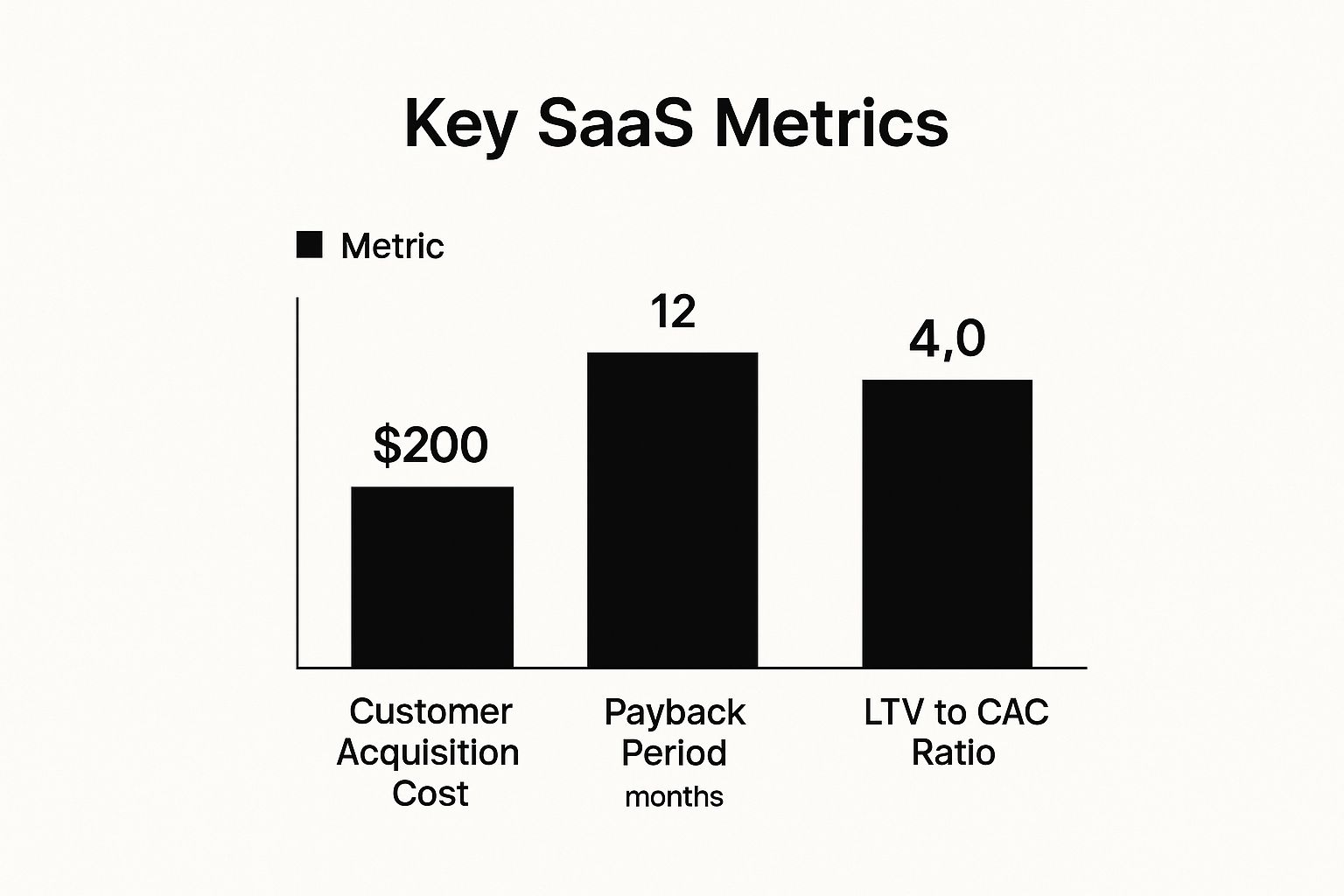
As you can see, these metrics don’t exist in a vacuum. They all work together, painting a holistic picture of your company’s health and growth potential.
Why Does CAC Vary So Much Across Industries?
One of the first things you’ll discover is there’s no universal “good” CAC. The cost to land a new customer can swing wildly from one SaaS sector to the next. A CAC that would sink one company might be a sign of healthy investment for another.
What causes these huge differences? It usually boils down to a few key factors:
- Product Complexity: More complex products demand more education and hand-holding to close a deal. Think demos, sales calls, and tailored proposals. This higher-touch sales cycle naturally drives up the cost of acquisition.
- Market Competition: If you’re in a crowded space, you have to shout louder (and spend more) to get noticed. Fierce competition for the same audience almost always inflates marketing and sales costs for everyone involved.
- Average Contract Value (ACV): This is a big one. A company with a high ACV can justify spending more to acquire a customer because the long-term payoff is so much greater. Enterprise SaaS, for instance, will always have a higher CAC than a simple tool for freelancers.
Average SaaS Customer Acquisition Cost by Industry
Let’s ground this in some real-world numbers. While the overall SaaS industry average CAC hovers around $702 per customer, that number is almost useless without segmentation.
For example, FinTech companies often face the highest CAC at roughly $1,450, thanks to heavy competition and regulatory hurdles. At the other end of the spectrum, e-commerce SaaS platforms have a much more manageable average of $274. You can dig deeper into these SaaS industry averages on Userpilot.
The table below breaks down typical CAC figures across different SaaS industries, giving you a better baseline for comparison.
This table shows the average CAC for various SaaS sectors, illustrating how costs differ based on market dynamics and product complexity.
| SaaS Industry / Sector | Average CAC | Key Influencing Factors |
|---|---|---|
| FinTech SaaS | ~$1,450 | High competition, strict regulations, and the need to build significant trust. |
| HealthTech SaaS | ~$950 | Long sales cycles due to compliance (HIPAA) and complex integrations with existing systems. |
| MarTech SaaS | ~$500 | A very crowded market, but many tools can be sold via low-cost, self-service models. |
| E-commerce SaaS | ~$274 | Often targets SMBs with simpler sales processes and lower price points. |
The data makes it clear: what’s considered “normal” depends entirely on your niche.
Key Takeaway: The goal isn’t simply to have the lowest SaaS customer acquisition cost. The real goal is to have a profitable CAC that is sustainable for your specific business model and industry.
Once you understand where your company fits into the broader landscape, you can shift from just calculating your CAC to actively managing it. This context is what empowers you to set smarter budgets, judge your marketing channels effectively, and build a truly scalable growth engine.
Proven Strategies to Reduce Your SaaS CAC
Knowing your SaaS customer acquisition cost is just step one. Once you have a handle on that number, the real work begins: lowering it without stalling your growth. A high CAC isn’t a reason to panic—it’s a signal telling you it’s time to fine-tune your acquisition engine.
The great thing is, you don’t have to tear down your whole strategy. Reducing CAC is all about making smart, data-backed tweaks across your entire customer journey. Every step, from the first ad they see to the moment they sign up, holds an opportunity to be more efficient.
This guide gives you a playbook of strategies you can actually use to lower your CAC. These aren’t just theories; they’re battle-tested tactics that top SaaS companies use to build more profitable and sustainable businesses.
Fine-Tune Your Funnel with Conversion Rate Optimization
One of the quickest ways to lower your CAC is to get more out of the traffic you already have. You’re already paying to get visitors to your site; Conversion Rate Optimization (CRO) is all about turning more of those clicks into actual customers.
Think of your marketing funnel as a leaky pipe. CRO is simply the process of patching those leaks. Even a small bump in your conversion rate can have a huge impact on your bottom line.
Here are a few high-impact areas to start with:
- A/B Test Your Landing Pages: Don’t just guess what works. Test everything—headlines, button text, images, form length. A tiny change can sometimes double your sign-ups.
- Simplify Your Sign-Up Process: Every field you ask for is another reason for someone to give up. Cut it down to the absolute essentials. The less friction, the more completions.
- Improve Website Speed: A slow website is a conversion killer, plain and simple. Make sure your pages load fast, especially on mobile.
By squeezing more value out of your existing traffic, you get more customers for the same ad spend. That directly pushes your average SaaS customer acquisition cost down.
Master Lower-Cost Acquisition Channels
Leaning too heavily on paid ads is a recipe for a sky-high CAC. Paid channels give you a quick sugar rush of traffic, but they’re expensive, and the leads stop the second you turn off the spend. For long-term health, you need to invest in channels that build on themselves.
Content marketing and SEO aren’t just expenses; they’re assets you build. A great blog post you publish today can keep generating leads for years to come, long after you’ve paid for it.
These organic channels create a flywheel effect, building momentum over time and creating a powerful, cost-effective way to get new customers.
- Content Marketing: Focus on creating genuinely helpful content that solves your ideal customer’s problems. This builds trust and attracts qualified leads who are already looking for what you offer. For more on this, check out our guide on effective B2B SaaS lead generation.
- Search Engine Optimization (SEO): Getting your site and content to rank on Google means potential customers find you at the exact moment they need a solution. Ranking for the right keywords is like having a sales team working for you 24/7, for free.
These strategies take more time to get going, but the payoff is a much lower and more predictable CAC.
Turn Your Product into a Growth Engine
What if your product could sell itself? That’s the simple but powerful idea behind Product-Led Growth (PLG). It’s a strategy where the product itself is the main driver for acquiring, converting, and keeping customers.
Companies like Slack, Calendly, and Dropbox grew into giants using this model, all with a far lower CAC than their sales-heavy competitors. They make it incredibly easy for people to try the product and see its value for themselves, usually with a freemium plan or a free trial.
A huge part of PLG is building virality right into the product. This means designing features that naturally encourage users to invite their friends and coworkers.
- Collaboration Features: If a tool is better with a team (think project management or design software), users will do the marketing for you by inviting their colleagues.
- Sharing Mechanisms: When users can easily share what they create with your tool (like a design from Canva), it organically introduces your product to new people.
- Referral Programs: Give your existing customers a reason to spread the word. A simple “give $10, get $10” offer can be an incredibly powerful and cheap acquisition channel, turning your biggest fans into your best salespeople.
When you nail PLG and virality, you create a growth loop where every new user brings in more users, dramatically cutting your need to spend big on traditional marketing and sales.
Your Top SaaS CAC Questions, Answered
Once you get the basics of SaaS customer acquisition cost down, the real questions start bubbling up. This is where the rubber meets the road, and learning to navigate these nuances is what separates the pros from the amateurs. It’s how you start using CAC to make genuinely smart business decisions.
Think of it like this: you’ve learned the rules of the game, and now you’re ready to talk strategy. Let’s dive into the questions I hear most often from founders.
How Often Should I Calculate My SaaS CAC?
My advice is to calculate CAC on two different cadences: monthly and quarterly. Each gives you a different, equally valuable lens on your business.
- Monthly checks are your early warning system. They’re fantastic for seeing the immediate results of a new marketing campaign or a pricing test. This lets you react fast and double down on what’s working, or kill what isn’t.
- Quarterly reviews give you a more stable, big-picture view. This longer timeframe smooths out the inevitable monthly blips—like a holiday promotion or a one-off viral post—so you get a more reliable baseline for strategic planning and forecasting.
Calculating it just once a year? That’s way too slow. The market moves too fast. By the time you get the data, you’ve already missed countless opportunities to fix your strategy.
Think of your CAC as a living, breathing metric. It’s not some static number you check once and forget. Regular tracking is what makes it a powerful tool, not just an interesting data point.
What’s the Difference Between “Fully Loaded” and “Non-Loaded” CAC?
This is a huge one, and getting it wrong can give you a dangerously inaccurate picture of your company’s health.
A “fully loaded” CAC is the gold standard, and it’s what I always recommend. It includes every single cost that goes into getting a new customer. The most important, and often forgotten, costs here are the salaries, commissions, and overhead for your sales and marketing teams.
On the other hand, a “non-loaded” CAC only counts direct advertising and program spending. Sure, it’s easier to calculate, but it paints a misleadingly rosy picture. It doesn’t show the true, complete cost of winning that customer. For honest, accurate planning, you absolutely have to calculate a fully loaded CAC.
How Do Freemium Models Change the CAC Calculation?
A freemium model definitely throws a wrench in the standard CAC formula, but it’s an easy fix. The key is to stay focused on who actually pays you.
You just need to adjust the formula slightly: Total Sales & Marketing Costs ÷ Number of New Paying Customers.
That’s it. All the money you spend acquiring and supporting your free users is simply treated as a marketing expense. You’re spending that money with the goal of converting a small slice of them into paying customers down the line. This approach almost always leads to a higher SaaS customer acquisition cost, and that’s okay. You just have to be extra diligent about tracking your free-to-paid conversion rate to make sure the model is working.
Market CAC: The Global Landscape
Where your business operates significantly influences your SaaS customer acquisition cost. Geographic variations can create up to 10x cost differentials globally due to varying levels of market maturity, labor costs, and advertising competition.
For an accurate assessment, companies must benchmark their numbers against others within the same specific market. A $500 CAC might be a massive win in the Silicon Valley ecosystem but could signal deep inefficiency in the growing tech hubs of Southeast Asia.
Benchmark Your Region
To understand the competitive landscape and see how your acquisition strategy stacks up, you can explore specialized databases and lists of active players in your specific territory:
- Check SaaS companies in United States – Explore the high-competition landscape of the world’s largest SaaS market.
- Check SaaS businesses in the United Kingdom – View fast-growing B2B players in the UK’s intensifying ecosystem.
- Check SaaS startups in Germany – Track the top-performing software companies in the European mainland.
- Check SaaS enterprises in India – Dive into the fastest-growing regional market in Asia-Pacific.
- Check SaaS innovations in Spain – See the top startups and investors fueling the Mediterranean tech scene.
- Check SaaS developments in Vietnam – Explore the emerging low-CAC opportunities in Southeast Asia.
- Check SaaS growth in Brazil – Review the trends driving Latin America’s primary SaaS economy.