
Knowing how to research a private company isn't just a nice-to-have skill in B2B sales; it's absolutely essential. Public companies are an open book, but private firms play their cards much closer to the chest. If you want to craft a pitch that actually resonates, you have to dig deep.
Why Researching Private Companies Is a B2B Game Changer

Think about publicly traded companies. They're legally required to share everything from quarterly earnings to major strategy changes. This makes them a pretty straightforward target for sales teams because all the information you need is out there for the taking.
Private companies are a whole different ballgame. They operate behind a curtain, with no obligation to publish detailed financial reports or announce every little move they make. This information gap is a huge hurdle for sales reps who need data to qualify leads and make their outreach personal.
Trying to sell to a private company without doing your homework is like trying to navigate a maze blindfolded. You'll probably get frustrated long before you find your way out.
Public vs Private Company Data Availability
Getting information on public vs. private companies requires completely different approaches. Here’s a quick summary of what to expect.
| Information Type | Public Companies | Private Companies |
|---|---|---|
| Financial Reports | Detailed quarterly & annual reports | Not publicly available; very limited access |
| Ownership | Publicly known (major shareholders) | Privately held; often undisclosed |
| Strategic Plans | Often disclosed in investor calls | Kept confidential; inferred from signals |
| Executive Info | Publicly listed with backgrounds | Basic info available; deep intel requires digging |
| Research Approach | Straightforward; review public filings | Investigative; connect disparate data points |
As you can see, the "easy" information just isn't there for private firms. You have to become a bit of a detective to piece together the full picture.
Moving Beyond Generic Sales Pitches
When you don't have good intel, what happens? Your outreach becomes generic. You're forced to send those one-size-fits-all messages that are incredibly easy for a busy decision-maker to ignore because they don't speak to any real, specific need.
Good research is what pulls you out of that trap.
Think of yourself as a detective building a case. Each piece of information—a new funding round, a key executive hire, or an expansion announcement—is a clue that helps you understand your prospect's story and what they need right now.
This deep understanding completely changes your sales approach. You're no longer making a cold call; you're starting a strategic conversation. You can frame your product as the solution to a problem you know they're facing, which instantly builds credibility and dramatically increases your odds of closing the deal.
This investigative work gives you a clear edge. While your competitors are blasting out generic emails, you're showing up with insights that prove you've done your homework.
The Strategic Value of Deeper Insight
When you get good at private company research, you can spot a prospect's needs before they even hit your competitor's radar. By tracking the right buying signals, you can engage a company at the perfect time—just as they've secured the budget and the motivation to solve a problem you can help with.
This turns your sales team from being reactive to being proactive consultants.
It's all about connecting the dots between different pieces of information to see the company's bigger picture. You're looking for clues like:
- Recent Funding: A fresh injection of cash almost always means they're about to spend on growth, new tech, and more people.
- Executive Changes: A new leader in the C-suite, especially a CRO or CTO, often signals a change in strategy and new budgets to go with it.
- Job Postings: If a company is suddenly hiring dozens of software engineers or sales reps, you know exactly where their focus is.
- Industry News: A mention in a trade publication can tip you off to a new product launch, a strategic partnership, or plans to enter a new market.
Understanding the Private Capital Ecosystem

Before you can research private companies effectively, you have to get a feel for the world they operate in: the private capital ecosystem. It’s a whole universe of investors, funds, and companies that exists outside the glare of the public stock market. This is where businesses are born, funded, and scaled, often long before an IPO is even a thought.
Unlike the public markets where information is everywhere, the private world runs on relationships and strategic deals. For a B2B sales pro, understanding the players and what drives them is everything. It’s what turns a simple funding announcement into a high-priority buying signal.
The Key Players in Private Capital
At its heart, the private capital world is all about different types of investment firms injecting cash into companies at various stages. If you know who's investing, you know a lot about a company's maturity and its immediate priorities.
You’ll mostly run into two main types of firms:
- Venture Capital (VC) Firms: These are the risk-takers. VCs pour money into early-stage startups with massive growth potential, betting that a few big wins will cover the rest. A VC-backed company is all about one thing: growth. Fast. They're focused on capturing market share and perfecting their product.
- Private Equity (PE) Firms: These investors play a different game. They typically buy into more established, mature private companies. The goal is to acquire a controlling stake, streamline operations, boost profitability, and then sell the company for a nice profit down the line. A PE-backed company is focused on efficiency and operational excellence.
Just knowing whether your prospect is VC- or PE-backed gives you a massive head start. One is flooring the accelerator, the other is fine-tuning the engine.
Decoding Funding Rounds and Deal Types
News about private company financing can look like a wall of jargon, but it’s packed with clues. The language used tells a story about where a company is headed and what it needs to get there.
A funding round isn't just about the money. It's a declaration of intent. It signals that a company has convinced sophisticated investors of its vision and now has the capital to execute on it.
And that's your cue. A fresh funding round is one of the clearest buying signals out there. It means new budgets have been unlocked for software, services, and talent to fuel that next stage of growth.
But it’s not just about individual deals. Look at the bigger picture: in the first quarter of the year alone, investment in key emerging markets hit USD 46 billion. Even with fewer deals happening, the high value shows a clear trend toward bigger, more strategic investments. This is backed up by the USD 18.6 billion in sponsor-to-sponsor investments, where fund managers are finding creative ways to generate returns. You can dive deeper into these Q1 2025 industry trends to see how things are shaking out.
Tools like Crunchbase are a goldmine for tracking these announcements.
This screenshot gives you a glimpse of how a platform like Crunchbase lays out all the critical data. You can see a company's funding history, who its investors are, and recent news all in one spot, saving you from hours of detective work. It’s the fastest way to get a solid read on a company's financial health and where it’s headed next.
Building Your Private Company Research Toolkit
Think of private company research less like a single magic bullet and more like a mechanic's toolbox. You wouldn't use a sledgehammer to tighten a tiny screw, right? The same logic applies here. For B2B sales, you need a mix of tools to pry open the right insights, and the secret is knowing which one to grab for the job at hand.
The good news? Your research stack doesn't have to break the bank. Some of the best intel is hiding in plain sight on free, public sources. The goal is to build a tiered approach, blending free, freemium, and premium tools to match your budget and how deep you need to go. This way, you've got the right firepower for every prospect, whether it’s a quick once-over or a full-scale investigation.
Foundational Free Resources
Let's start with the basics—the tools that cost you nothing but a bit of time. These are perfect for that initial prospecting phase where you're just getting a feel for a company.
- LinkedIn & Sales Navigator: This is ground zero for people-intel. You can use it to sketch out org charts, pinpoint the key decision-makers, and even spot recent executive hires. A new VP of Engineering, for example, is a huge tell—it often signals a new tech stack is on the horizon.
- Government Business Registries: It might not be the most exciting part of the job, but checking a company's status on a Secretary of State website is a crucial step. It confirms their legal name, when they registered, and their official address, validating you're chasing a real, active business.
- Local and Trade News: Never underestimate the power of a finely-tuned Google News search. Finding a mention in a local business journal about a new office lease or a factory expansion is pure gold. It’s a direct signal of growth, investment, and potential need.
Freemium Platforms for Deeper Insights
Okay, you've found a promising lead. Now it's time to dig a little deeper. Freemium platforms are great for this next step, offering a ton of data for free with paid options for when you need more. They're especially good for getting a sense of a company's financial momentum.
A huge part of this is understanding the core performance metrics that investors care about. This simple diagram breaks down how a company's growth and profitability ladder up to its overall market value.
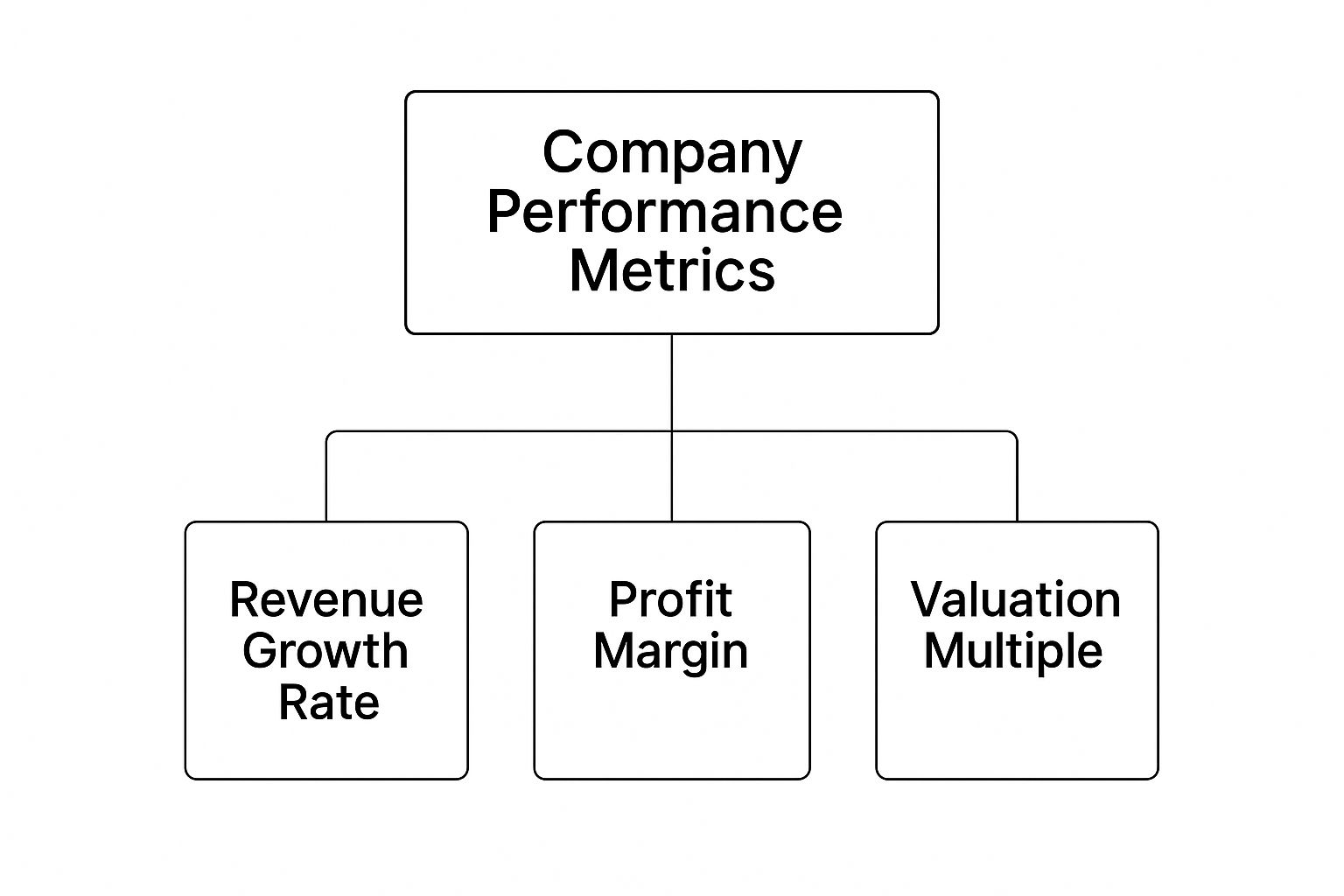
As you can see, things like revenue growth and profit margin aren't just numbers on a spreadsheet; they directly influence how investors value the business. That makes them critical indicators of a company's health and potential.
One of the most well-known freemium tools is Crunchbase. It’s fantastic for tracking funding rounds, investors, and acquisitions. A quick search can tell you when a company last raised money and who from, giving you a much clearer picture of their financial runway and growth ambitions.
Premium Databases for Granular Data
When you're dealing with your most strategic, high-value accounts, it's time to bring out the heavy hitters. Premium databases provide the kind of deep, verified data that's almost impossible to find anywhere else. These are the power tools in your research kit.
Premium databases are what turn your research from educated guesswork into a data-driven strategy. They give you the verified financial and operational details you need to build an undeniable business case.
These platforms are an investment, no doubt. But the ROI is a massive competitive edge, helping you understand a company's complete financial story, not just the parts they publicize.
- PitchBook: This is a beast for deep financial data, M&A details, and complex investor info. Use it to see a company’s full cap table, its valuation history, and the track record of its private equity or VC backers.
- Mattermark: A great tool for lead generation, Mattermark helps you spot fast-growing companies by tracking data signals like web traffic and social media trends to create growth scores. It’s perfect for prioritizing who to reach out to first.
- Specialized Databases: Many industries have their own go-to data platforms. If you're looking for more options, exploring different company information databases can help you find a tool perfectly suited to your niche.
Comparing Private Company Research Tools
To make it easier to see where each tool fits, here’s a quick breakdown of the different categories, what they're best for, and what you can expect to pay.
| Tool Category | Examples | Best For Finding | Cost Level |
|---|---|---|---|
| People Intelligence | LinkedIn, Sales Navigator | Decision-makers, org charts, career histories | Free to $$ |
| Funding & M&A Data | Crunchbase, PitchBook, CB Insights | Funding rounds, investors, valuations, acquisitions | Freemium to $$$$ |
| Growth Signals | Mattermark, Similarweb | Web traffic, social trends, hiring surges | Freemium to $$$ |
| Public Records | Secretary of State Websites | Legal entity status, registration details | Free |
Each category serves a different purpose, from finding the right person to understanding the company's entire financial health.
By weaving these different tiers together, you create a research process that's both powerful and flexible. You can qualify leads quickly with free tools, enrich your understanding with freemium platforms, and then go all-in on your top-tier prospects with premium data. This balanced approach ensures you spend your time and resources right where they'll have the biggest impact.
How to Spot High-Value Buying Signals

Raw data is just noise. The real magic in private company research happens when you start connecting the dots and finding patterns that scream, "They need us!" These patterns are buying signals, and learning to see them is what separates the average salesperson from the top 1%.
Think of yourself as an air traffic controller. To an untrained eye, the radar screen is just a chaotic mess of blinking dots. But the controller sees clear flight paths, potential collisions, and precise arrival times. You need to look at company data with that same trained eye, turning random facts into a clear path to a sale.
A buying signal is simply an event or a change suggesting a company is about to need your product. It’s a trigger that tells you a new challenge, a new budget, or a new priority has just popped up on their radar.
Growth Triggers and What They Really Mean
Some events are practically a flashing neon sign for a future spending spree. When you see one of these, it’s time to lean in. They don’t just tell you that a company is growing; they show you how it's growing.
Here are a few of the most powerful growth triggers to look out for:
- A recent funding round: This is the most obvious one. Fresh cash means new projects, more hiring, and a need for new tools to make it all happen.
- A spike in job postings: A company suddenly hiring ten software engineers? They're definitely building something new. A dozen new sales reps? They're about to hit the gas on their go-to-market strategy.
- New executive hires: A new CRO is going to re-evaluate the entire sales toolkit. A new CTO will audit all the existing technology. These leadership changes create huge windows of opportunity.
- Geographic expansion: Opening a new office signals a major investment in new infrastructure, from IT services to local marketing and sales support.
A buying signal isn't just an event; it's the beginning of a story. Your job is to understand the plot, identify the main characters, and figure out how your solution helps them reach a happy ending.
The context behind each signal is what truly matters. A funding round is great news, but digging into who the investors are and what they typically focus on will tell you a lot more about where that money is likely going.
Turning Company News into Customer Needs
Beyond the big, obvious triggers, you can find opportunities hidden in news about mergers, product launches, or major partnerships. This is where you graduate from being a data-gatherer to a trusted advisor.
Let's say a company just acquired a smaller competitor. What headaches are they about to face?
- Technology Integration: They now have to merge two completely different tech stacks, databases, and internal systems. That’s a massive project that almost always requires new software.
- Cultural Alignment: They need to blend two different cultures and teams. This makes tools for communication and project management incredibly important.
- Customer Consolidation: They have to move customers from the old platform to the new one without losing them. This creates an immediate need for better customer success and support solutions.
Every one of these challenges is a potential sales opportunity. By thinking ahead, you can show up with a specific solution to their real-world problem instead of a generic pitch.
If a company announces a big product launch, they’re going to need help with marketing, sales enablement, and customer onboarding—right now. For a deeper look at the numbers behind these moves, our guide on how to find private company financial information is a great resource.
The bigger picture of the global investment world also gives you powerful clues. For instance, private capital deal activity recently saw a massive rebound, with a 19% jump in deal value across key markets. Central and Eastern Europe was a particular hot spot, with investment skyrocketing 187% to USD 7.2 billion, helped by huge deals like a USD 500 million funding round for Turkey's Insider platform.
This trend shows that investors are confident and ready to fuel growth, which means more opportunities for sales teams paying attention. By connecting these large-scale trends to what’s happening at individual companies, you can build a compelling story that makes your outreach impossible to ignore.
Turning Your Research into Compelling Outreach
This is where the rubber meets the road. All that digging and detective work you did? It's about to pay off. Solid research on a private company isn't just for show—it's the fuel for crafting messages that busy decision-makers actually want to open.
The whole point is to move from a pile of facts to a real conversation. You're trying to prove you've done more than just glance at their LinkedIn profile for two minutes. You're showing up as a potential partner, not just another vendor with their hand out.
The goal isn't just personalization; it's relevance at scale. Let's be real, you don't have time to write a custom novel for every single prospect. What you need is a smart framework—a way to plug one powerful, research-backed insight into your outreach. That single, relevant detail can be the difference between getting a reply and getting sent straight to the trash folder.
Think of it like this: a generic email is like a junk mail flyer for a pizza place you'd never order from. But a research-backed email? That's like a handwritten note from a neighbor who noticed your new garden and has the perfect tool to help with the weeds. One gets ignored, the other gets a second look.
From Insight to Introduction
Your opening line is the most valuable piece of real estate in your entire message. Wasting it on fluff like "I hope this email finds you well" is a rookie mistake. Instead, lead with the single most interesting thing you found in your research. It instantly shows you've done your homework and have a good reason to be in their inbox.
This is where your research directly shapes your hook.
- Found a funding announcement? Start by congratulating them on their recent Series B. Then, mention a common growing pain you know companies face right after a big cash injection.
- Spotted a new executive hire? Reference their new title and connect it to a strategic priority you know is part of their job, like rebuilding the tech stack or expanding into a new market.
- Read about a product launch? Acknowledge the launch and ask a smart question about how they’re handling the new influx of users or support tickets.
This simple shift flips the script entirely. Instead of begging for 15 minutes of their time, you’re offering an observation that’s directly tied to what’s happening in their world right now.
A Tale of Two Pitches
Let’s make this concrete. Imagine you're selling a project management tool to a growing tech company.
Pitch 1: The Generic Approach
"Hi [Name],
I'm reaching out because I saw you're the VP of Engineering at [Company Name]. My company offers a project management solution that helps teams improve efficiency. Can we schedule 15 minutes to chat next week?"
This email is bland, self-serving, and provides zero value. It’s destined for the delete button because it could have been sent to literally anyone.
Pitch 2: The Research-Backed Approach
"Hi [Name],
I noticed on LinkedIn that your engineering team has grown by 30% over the last six months—congratulations on the rapid expansion.Companies I work with often find that this level of growth puts a major strain on their old project management workflows. How are you adapting your processes to keep everyone aligned?
I have a few ideas that have helped other VPs of Engineering in a similar growth phase. Would it be worth a brief chat next week?"
The difference is night and day, right? The second pitch leads with a specific number, diagnoses a highly probable pain point, and frames the entire conversation around solving their problem. It proves you did your private company research and shows you respect their time.
The most effective outreach doesn't sell a product; it sells an understanding of the prospect's problem. Your research is what allows you to diagnose that problem before you even start the conversation.
By structuring your outreach this way, you change the whole dynamic. You’re no longer just another salesperson asking for a meeting. You become a potential advisor offering a valuable perspective. This strategy is a core part of effective competitive intelligence gathering, positioning you based on a real understanding of their world. Your research becomes your best tool for opening doors and building trust from the very first hello.
What’s Happening in the Private Markets Right Now?
The private capital world is always in motion, reacting to economic swings and new tech. If you're in B2B sales, keeping a finger on the pulse of these changes isn't just a "nice-to-have"—it's a critical part of your private company research. When you get the big picture, you can pitch your solution as a strategic asset for the future, not just a tool for today.
Two major forces are shaking things up and changing how private companies operate and spend their money. First, the explosion of generative AI is creating entirely new challenges and opportunities. And second, there's been a big shift in how investors make their money, moving from clever financial tricks to rolling up their sleeves and improving the business itself.
Generative AI is Creating Huge Openings
Generative AI isn't just hype; it's a real operational game-changer. Private companies are scrambling to bring AI into their workflows to boost efficiency, automate routine tasks, and even dream up new products. For sales reps, this is a massive green light.
Think about it: a company diving into AI needs new infrastructure, better data tools, and specialized software to connect all the dots. These are powerful buying signals. Your research should be on the lookout for clues—things like "AI" popping up in job postings or being mentioned in company news. That’s a sign they’re actively investing.
The Focus Has Shifted from Financial Tricks to Real Business Improvements
For a long time, a lot of private equity deals were all about financial engineering. This meant restructuring debt or making other fancy financial moves to make a company look more valuable on paper. That playbook is getting old. Today, the real focus is on making genuine, lasting improvements to how the business actually runs.
Fund managers are now acting more like hands-on partners, getting into the weeds to help their companies get better. They want to see tangible results, like a smoother sales process, a more efficient supply chain, or happier customers who stick around.
This shift means investors are on the hunt for tools and services that deliver real, measurable value over the long haul. Your product is no longer just another expense; it’s a core piece of their plan to grow the business.
This new investor mindset has a direct impact on how you sell. When you can clearly show how your solution helps hit specific operational goals, you’re speaking their language and aligning with the core strategy of both the company and its investors.
Even with challenges like higher interest rates, the private markets have stayed surprisingly strong. While fundraising has dipped, the amount of capital actually being invested has gone up, which tells us investors are still very much in the game. Innovation, led by generative AI, has forced fund managers to pivot, focusing more on operational makeovers to create value. You can dig deeper into these global private market transitions from McKinsey.
By keeping these big-picture trends in mind, your research becomes so much more powerful. You can start to predict what a prospect will need based on where the market is going, allowing you to tailor your outreach to solve tomorrow's problems, not just today's.
Frequently Asked Questions
Even with the best game plan, digging into private companies can feel like trying to solve a mystery. Let's tackle some of the most common questions that pop up for B2B sales pros. These answers will help you navigate those tricky spots and turn the advice in this guide into real-world action.
How Can I Find a Private Company's Revenue?
This is the million-dollar question, isn't it? Since private companies don't have to open their books to the public, finding an exact revenue number is nearly impossible. So, stop looking for one.
Instead, think of yourself as a detective building a case. Your goal is to create a smart, educated guess. You can get surprisingly close by piecing together a few clues:
- Industry Benchmarks: Start by figuring out the average revenue per employee in their specific industry. A quick Google search can often get you in the ballpark.
- Employee Count: Jump on LinkedIn and see how many people they employ. Multiply that number by the industry benchmark, and you've got a solid starting point.
- Funding Information: Check out a platform like Crunchbase to see how much money they've raised from investors. A big, recent funding round usually means they have aggressive growth targets and the cash to back them up.
When you combine these data points, you can build a logical revenue estimate that’s more than enough to guide your sales approach.
What Is the Best Free Tool for Research?
When you're working with a tight budget, LinkedIn is your absolute best friend. Hands down. While other tools have their place, nothing gives you a better free look inside a private company's world.
Think about it: you get a headcount, a list of key decision-makers (and their work history), and updates on new hires. You can't get that level of detail anywhere else for free. Pair that people-centric data with a few smart Google searches for recent news, and you've built a powerful, zero-cost research foundation.
How Much Time Should I Spend on a Prospect?
This is simple: the time you spend researching should match the deal's potential size. It’s a huge mistake to spend the same amount of time on every single account. You'll burn out chasing small fish and neglect the whales.
A tiered approach ensures your deepest research efforts are reserved for your most valuable prospects, maximizing the return on your time.
Here’s a simple framework that works wonders:
- Tier-One Prospects: These are your white whales. For these high-value accounts, block off 30-60 minutes for a deep dive. The goal here is to find that one killer insight that makes your outreach stand out from the noise.
- Tier-Two & Three Prospects: For everyone else, keep it quick and focused. A 10-15 minute scan is perfect. Just look for major buying signals—a recent funding round, a big product launch, or a new C-level executive coming on board.