
Modern prospecting is a whole different ball game. It’s less about brute force and more about finesse—blending smart research with a strategic outreach plan to build real connections. The goal isn't just to play the numbers; it's about getting the right message to the right person at the right time to solve a problem they actually have.
The New Rules of Effective Prospecting

Let's be honest, the days of blasting a generic email to a purchased list and praying for a reply are long gone. Sales cycles are stretching out, and more people than ever have a say in every buying decision. To win, you have to be much more thoughtful. It's all about quality over sheer quantity.
This fundamental shift means your entire prospecting effort has to be built on a foundation of real value and personalization. You have to prove you've done your homework and understand your prospect's world before you ever ask for a minute of their time. This guide is designed to move you past those outdated tactics and give you a framework that actually works today.
More Decision-Makers Complicate the Process
The modern B2B buying landscape is crowded. The average Decision-Making Unit (DMU) now involves around 4.14 stakeholders. What's even more telling is the 180% increase in DMUs with five or more members in just the last two years.
Think about that. And get this—7% of purchasing decisions now involve 10 or more people.
This reality changes everything. It's no longer enough to find one contact. You have to map the entire organization to understand who holds the influence, who controls the budget, and who will be the end-user of your solution. To learn more about how these buying committees are changing the game, check out this resource on B2B SaaS lead generation.
The core challenge of modern prospecting isn't just getting a response; it's navigating a complex web of influencers and decision-makers within a single target account. Your strategy must account for this from the very beginning.
To get ahead, you need a system that's both disciplined and adaptable. Below are the essential components—the core pillars—that will keep your pipeline full and your conversations meaningful.
Core Pillars of Modern Prospecting
| Pillar | Key Action | Why It Matters |
|---|---|---|
| Deep Research | Go beyond a LinkedIn profile. Dig into company reports, press releases, and industry news to find real pain points. | This is how you craft a message that resonates instead of getting deleted. It shows you care. |
| Multi-Channel Outreach | Combine email, phone calls, social media, and even video to connect with prospects where they actually spend their time. | People have different communication preferences. Using multiple channels triples your chances of being seen and heard. |
| Persistent, Value-Driven Follow-Up | Don't just "check in." Share useful articles, insights, or case studies that help your prospect, even if they never buy. | This builds trust and positions you as an expert resource, not just another salesperson. It keeps you top of mind. |
By mastering these three areas, you're not just sending messages into the void. You're building a repeatable, scalable process that turns cold outreach into warm, productive conversations. This integrated approach is what separates the top performers from everyone else.
Building Your Ideal Prospect Profile
Before you write a single line of an email or even think about picking up the phone, you have to do the real work. The success of your prospecting efforts comes down to one thing: knowing exactly who you’re trying to reach. If you don't have a clear target, you're just shouting into the void.
This is where building an Ideal Customer Profile (ICP) becomes the most important thing you'll do. An ICP isn't just a vague description; it's a living, breathing document that outlines the perfect company for your solution. We're not talking about just any company, but the ones that will get massive value from what you offer and, in turn, become your best, most loyal customers.
Think of your ICP as the blueprint for your entire sales strategy. It dictates where you look, what you say, and ensures you're not wasting a single minute on opportunities that were never going to close anyway.
From Company Data to Human Insights
A solid ICP goes way beyond the basics like industry, company size, and annual revenue. Those are a good start, but the real gold is in the details that signal a company is a perfect match.
You need to understand what's happening inside the business. Are they hiring like crazy? Did they just land a new round of funding? What technology are they already using? These are the company-level signals that tell you if an organization has the need, the budget, and the right setup to even consider your solution.
Here are a few data points I always start with when building an ICP:
- Industry and Niche: Get specific. Not just "tech," but "B2B SaaS for enterprise-level data security."
- Company Size: Look at both employee count and revenue. These are key indicators of their budget and how complex their problems are.
- Geographic Footprint: Where are their headquarters? Where do they actually do business?
- Technology Stack: Knowing what CRM, marketing automation, or other tools they use can reveal huge opportunities for integration—or weaknesses in their current setup that you can solve.
- Growth Signals: Keep an eye out for funding announcements, big hiring sprees (especially in departments you sell to), or recent acquisitions.
A well-defined ICP is your filter. It gives you the confidence to say "no" to bad-fit companies fast, so you can pour all your energy into the accounts that matter.
Once you’ve nailed down the company profile, it's time to zoom in on the people inside. This is where you develop your buyer persona, which is a sketch of the specific roles and titles you'll be talking to. For a fantastic guide on getting this right, check out this B2B buyer persona template—it’s great for structuring your thoughts.
Uncovering Triggers and Pain Points
Knowing who to call is only half the puzzle. The other half is understanding why they would ever want to talk to you. You need to get inside their heads and identify their real-world challenges, goals, and what keeps them up at night.
For instance, instead of just saying your target is a "VP of Sales," a great persona gets specific about their pain points: "Struggling to get accurate sales forecasts from their team" or "Frustrated by the low adoption rate of their current CRM."
This is how you move from a generic pitch to a conversation that actually resonates.
A perfect example of this is looking for buying triggers. A job change is one of the most powerful ones out there. New leaders are almost always brought in to make changes and are far more open to new ideas and tools.

With a tool like LinkedIn Sales Navigator, you can easily build lists of people who have started a new role in the last 90 days. Reaching out to them with a message that acknowledges their new position makes your outreach incredibly timely and relevant.
Your goal is to build a profile so detailed that when you finally reach out, it doesn't feel like a cold call. It feels like a helpful, well-informed conversation. This foundational work is what separates the top performers from everyone else.
Choosing Your Outreach Channels Wisely
Alright, so you’ve figured out who you're targeting. Now for the million-dollar question: how do you actually reach them? Gone are the days when you could just blast out a thousand emails and hope for the best. A one-size-fits-all approach just doesn't work anymore.
Your prospects are everywhere—jumping between email, scrolling through LinkedIn, and, yes, even answering their phones. Your job is to show up in the right places at the right time. This isn’t about spamming them on every platform. It's about crafting a smart, cohesive outreach that feels less like a sales pitch and more like a natural conversation unfolding across different channels.
The Power of a Multi-Channel Mix
Let's be real: prospecting is tough. In fact, 42% of salespeople say it's the hardest part of their job. It's easy to see why. While email is still a beast—preferred by 80% of prospects—relying on it alone is a rookie mistake.
Think about it. A well-timed phone call can be incredibly powerful, especially with senior leaders. Data shows 57% of C-suite buyers actually prefer a call. And don't sleep on other channels. A strategic approach on LinkedIn can yield 21% engagement, and connecting at industry events can be even better, with 34% engagement. The goal is to build a well-rounded strategy that gives you the best shot at cutting through the noise.
You can dig into more sales statistics and insights to see what's working right now.
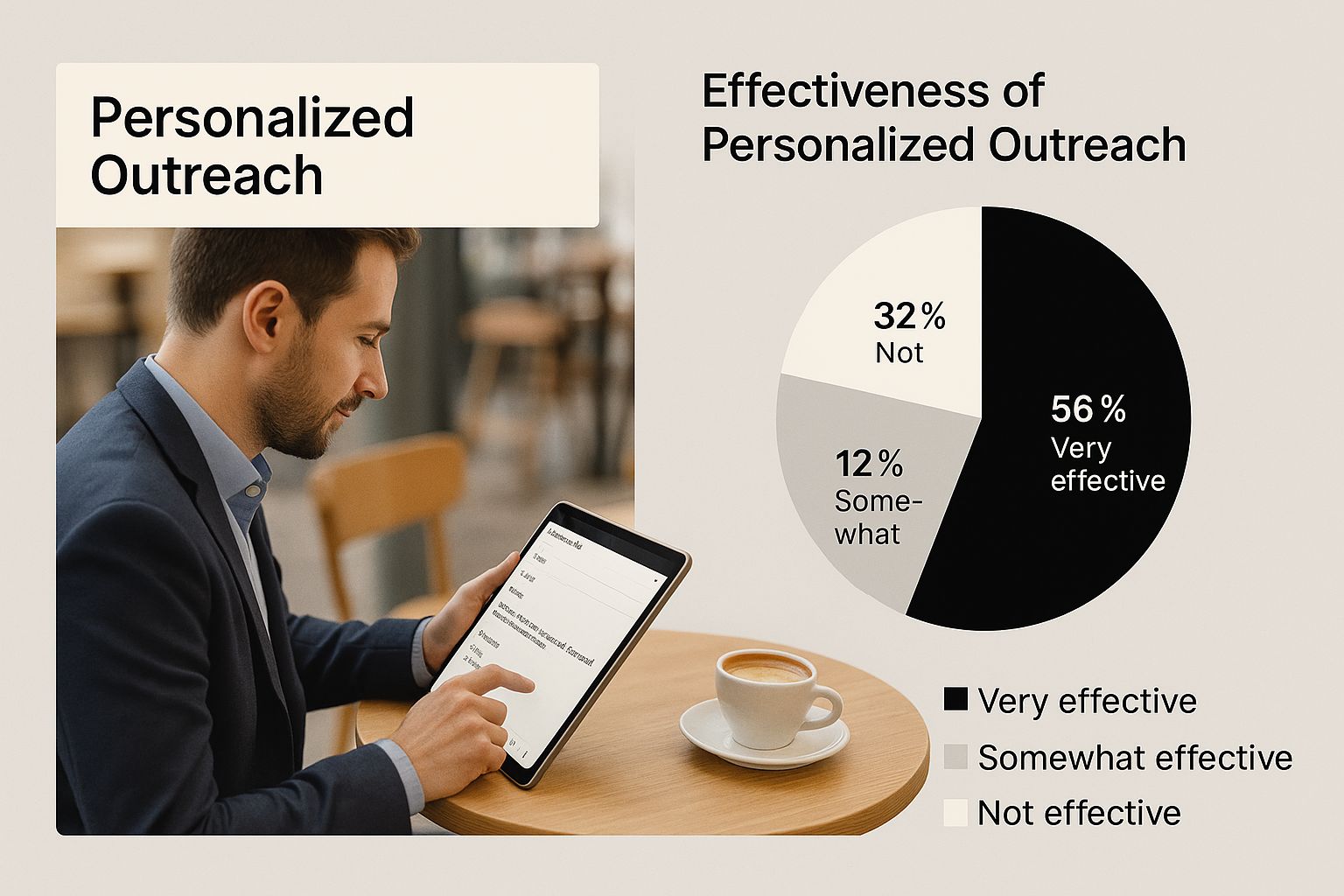
The big takeaway here? How you deliver the message is just as important as the message itself. Personalizing your outreach for the right channel and the right person is what separates the pros from the amateurs.
Selecting the Right Channels for Your ICP
The perfect mix of channels always comes back to your Ideal Customer Profile (ICP). A startup CTO probably lives on LinkedIn and might respond to a sharp, direct email. But a seasoned executive in manufacturing? They might delete that email without a second thought but pick up a call from a number they don't recognize.
Here's how I think about the big three B2B channels:
- Email: This is your foundation. It’s perfect for sending detailed, value-packed messages, sharing helpful resources, and moving conversations forward. The best part is its scalability, but the biggest challenge is standing out in a crowded inbox.
- LinkedIn: Think of this as your social command center. It’s where you do your initial recon, warm up a contact with a profile view or a thoughtful comment, and send a personalized connection request before you ever hit their inbox.
- Phone: This is your high-impact play. Nothing cuts through the digital clutter like a direct call. It’s often the quickest way to get a straight answer, but I'd save it for high-value prospects or as a follow-up after you've already engaged with them online.
Expert Tip: Don't treat your channels like separate silos. Great prospecting makes them work together. A simple LinkedIn profile view can make your follow-up email feel warmer, and a compelling email gives you the perfect excuse to make a call.
Prospecting Channel Effectiveness Comparison
Choosing the right channel at the right time is more art than science, but understanding their strengths and weaknesses is a great starting point. Here's a quick look at how the top channels stack up for B2B outreach.
| Channel | Best For | Success Tip | Key Statistic |
|---|---|---|---|
| Scalable outreach, sharing detailed information, and nurturing leads over time. | Focus on extreme personalization in the subject line and first sentence to stand out. | 80% of prospects prefer to be contacted by sellers via email. | |
| Phone | High-value prospects, direct conversations, and quickly qualifying or disqualifying leads. | Reference a prior touchpoint (email, LinkedIn) to warm up the call immediately. | 57% of C-level executives prefer contact by phone. |
| Research, social selling, building rapport, and engaging prospects before the first direct outreach. | Engage with their content (like, comment) before sending a connection request. | 21% engagement rate for prospecting activities on the platform. | |
| Events | Building strong, face-to-face relationships and connecting with multiple stakeholders at once. | Have a plan for who you want to meet, but also be open to spontaneous conversations. | 34% engagement rate makes in-person one of the most effective channels. |
Ultimately, the best strategy combines these channels into a sequence where each step logically follows the last, creating a unified and professional experience for your prospect.
Weaving Channels into a Cohesive Sequence
Building an effective outreach sequence is all about momentum and logic. You wouldn't walk up to a stranger and immediately ask for a meeting, right? The same principle applies here. You need to earn their attention.
Here's a simple, practical multi-channel sequence you can steal:
- Day 1 (LinkedIn): Start subtle. View their profile and maybe like or comment on a recent post. It’s a low-pressure way to get on their radar.
- Day 2 (Email): Send your hyper-personalized cold email. Make it clear you've done your homework and connect their problems to a specific insight you have.
- Day 4 (LinkedIn): Now send the connection request. Keep the note short and contextual. Something like, "Hi [Name], I sent you an email a couple of days ago about [topic]. Would love to connect here too."
- Day 6 (Email): Time for a follow-up. Keep it brief. Don't just say "bumping this up"—add a new piece of value, like a link to a case study or a short article they might find interesting.
- Day 8 (Phone): Make the call. By this point, you're not a total stranger. You can reference your emails and LinkedIn connection to create a much warmer opening for the conversation.
This methodical approach respects your prospect’s time and builds familiarity step-by-step. By blending digital groundwork with direct, human outreach, you massively increase your odds of starting a real conversation and landing that all-important first meeting.
Crafting Messages That Actually Get Replies
Let’s be honest: all the research in the world won’t help if your actual message falls flat. Your email or LinkedIn message is your digital handshake. It’s your first impression, and you rarely get a second chance to make it.
The secret to getting a reply isn't some magic template or a slick trick. It's much simpler than that. You have to stop thinking about what you want to sell and start thinking about what problem you can help them solve. Your message needs to instantly prove you've done your homework and respect their time.
The Anatomy of a Winning Message
Every single word counts, from the subject line all the way to your sign-off. Your goal is to make hitting "reply" feel like the most natural next step for them. Think of your message in three core parts that work together to earn that response.
Here’s what a great message needs:
- A Subject Line That Sparks Curiosity: This isn’t about writing clickbait. It’s about being short, specific, and often personalized. Ditch generic stuff like "Intro" or "Quick Question."
- A Hyper-Personalized Opening Line: Your first sentence is where you prove this isn't a blast to 1,000 people. Reference something specific you found in your research—a recent company announcement, a LinkedIn post they shared, or even a mutual connection.
- A Simple, Low-Effort Call-to-Action (CTA): End with an easy question. Instead of asking for a 30-minute demo next week, which feels like a big commitment, try something like, "Is this a priority for your team right now?" That simple shift moves the focus from scheduling to discovery.
Ditch the "Me" Pitch for a "You" Conversation
This is the biggest mistake I see salespeople make. They lead with their product. Your prospect doesn't care about your features or your company's awards—at least, not yet. They care about their challenges, their goals, and their world.
Your message needs to act like a mirror, reflecting their reality back at them.
The "Me-Focused" Pitch (What to Avoid):
"Hi Jane, I'm with Acme Corp, and we provide a revolutionary platform that streamlines workflow automation for sales teams. We’ve helped companies increase efficiency by 30%. Can we schedule a demo?"
This is all about Acme Corp. It’s generic and screams "sales pitch."
The "You-Focused" Opener (What to Do):
"Hi Jane, I saw your recent post on LinkedIn about the challenges of scaling your SDR team. Getting new reps ramped up while maintaining forecast accuracy is a tough balance. Have you considered how automating non-sales activities could give them more time for coaching?"
See the difference? This one is entirely about Jane. It shows you're paying attention, you understand her problems, and you're offering a relevant idea, not just a product.
The Undeniable Power of Personalization
Personalization is so much more than just dropping [First Name] into a template. It's the engine that drives modern prospecting. The data backs this up, too. For instance, emails with personalized subject lines are a whopping 26% more likely to be opened.
Personalized content can also boost transaction rates sixfold compared to generic messages. It's a clear signal to your prospect that you've invested time to understand their specific situation before asking for theirs. You can discover more insights from these new business statistics.
This is where all that research you did earlier really pays off. You can weave those little details into your message to create a powerful hook that proves you're relevant from the very first line. If you're looking for inspiration on how to structure these, checking out some battle-tested B2B cold email templates can give you a great starting point to build your own.
At the end of the day, writing a message that gets a reply is an exercise in empathy. It’s about showing genuine interest and offering value before you ever ask for anything in return. This approach turns your outreach from an annoying interruption into a welcome, relevant conversation—and that's the first step toward building a real business relationship.
Don’t Give Up: The Real Work Starts with the Follow-Up
Let's be honest, the real work of prospecting starts after you send that first message. Very few deals are won on the first try. They’re earned through smart, professional persistence, which is exactly where most salespeople stumble and give up way too soon.
I like to think of it this way: your first email plants a seed. The follow-up is you carefully watering it and making sure it gets sunlight. If you just plant the seed and walk away, you can’t really expect anything to grow, can you?
The Glaring Gap in Sales Persistence
There’s a huge disconnect between what it actually takes to get a response and how much effort most reps put in. The numbers are pretty eye-opening: 80% of sales require five or more follow-ups to finally close. And yet, a staggering 92% of salespeople throw in the towel after only four attempts.
That gap is your single biggest opportunity. If you can simply build a system to be professionally persistent, you’re already ahead of almost everyone else in your field. If you want to dive deeper, there are plenty more valuable sales statistics that highlight just how critical this is.
The point of a follow-up isn't to be annoying. It's about staying on their radar by consistently offering value. You're trying to show you’re a helpful resource, not just another salesperson with their hand out.
Mastering this part of the process is how you turn a completely cold lead into a warm conversation. You’re playing the long game, building trust, and earning the right to their time.
How to Build a Follow-Up Sequence That Adds Value
A good follow-up sequence never, ever includes the phrase "just checking in." Every single time you reach out, you need a clear purpose and something genuinely useful to offer the prospect. This is how you demonstrate your expertise and show you’re committed to helping them, one small touchpoint at a time.
You'll also want to mix it up. Don't just live in their email inbox. A great sequence uses multiple channels—email, LinkedIn, maybe even a phone call—to increase your chances of getting noticed. It shows you respect their preferences and keeps you from becoming easy-to-ignore background noise.
Here's what a value-first sequence might look like in the real world:
- Email 2 (3 days later): Find a relevant, no-strings-attached resource. It could be a link to an industry article you found interesting, a podcast episode, or a report that touches on a pain point you think they have.
- LinkedIn Touchpoint (5 days later): Go engage with their content. A thoughtful comment on something they shared can be way more effective than another DM.
- Email 3 (8 days later): Tie your outreach to a recent company event. For example, "Hi [Name], I saw your company just announced [X recent news]. Congrats! That kind of growth often brings challenges with [Y]. I thought this quick case study on how we helped [Similar Company] through that same phase might be helpful."
- Phone Call (10 days later): Now that you've built some context and familiarity, a call doesn't feel so cold. You can easily reference your previous messages as a natural way to start the conversation.
The Last Resort: The "Break-Up" Email
Okay, so you’ve followed up several times, provided real value, and still… crickets. It’s time for the break-up email. This isn’t a passive-aggressive guilt trip; it’s a professional and respectful way to close the loop on your end.
The message is simple. You politely let them know this will be your last email because you don't want to clutter their inbox. Then, you leave the door open for them to get in touch if and when the time is right.
For instance:
"Hi [Name], I've reached out a few times about [topic] and haven't heard back, so I'll assume this isn't a priority right now. I won't follow up again, but please feel free to get in touch if that changes."
You would be amazed at how many responses this email gets. It takes all the pressure off and often nudges the prospect to finally reply, making it one of the most effective, counterintuitive tools in your entire toolkit.
Using Tech to Prospect Smarter, Not Harder
Let's be real: technology isn't a magic wand for prospecting, but it's an incredible force multiplier. The right tools don't replace the human touch in sales. Instead, they get rid of the mind-numbing, tedious tasks so you can actually focus on what matters: building relationships and having real conversations.
Think of your sales tech stack as your backstage crew. They handle all the heavy lifting so you can shine on stage.
Trying to prospect manually is a fast track to burnout. Imagine spending your day digging for contact info, logging every little thing in a spreadsheet, and then trying to remember to send follow-up emails one by one. All that admin work is a massive time-suck, pulling you away from the one activity that actually drives revenue—connecting with people.
Building Your Prospecting Tech Stack
You don't need a dozen expensive, flashy tools to get the job done. A simple, well-chosen tech stack can completely change your daily workflow for the better.
Your setup should really nail a few key areas:
- CRM (Customer Relationship Management): This is your command center. It's where you keep all your prospect data, track every interaction, and manage your entire pipeline. It's basically your second brain.
- Lead Intelligence Software: Tools like Saasdatabase.net are fantastic for finding and verifying contact data. They give you accurate emails and phone numbers, plus key insights about the company you're targeting.
- Sales Engagement Platforms: These tools let you build and automate your outreach across different channels (email, social, calls). They make sure you never let a follow-up slip through the cracks.
- Scheduling Tools: A simple scheduling link is a game-changer. It eliminates that endless back-and-forth of "what time works for you?" and makes it dead simple for an interested prospect to book a call with you.
The whole point is to get these tools talking to each other, creating a smooth process that frees you up to do the high-value work only a person can do.
Technology lets you personalize your outreach at a scale that's just impossible to do by hand. It gives you the data you need to be relevant and the automation you need to be consistent.
The Real-World Impact of Good Tools
Here's the thing: top-performing sales teams lean heavily on technology. A study found that high-performing sales teams use nearly three times more sales tech than underperforming ones. They aren't just using it for basic email blasts, either. They're digging deep into prospect intelligence and tracking engagement, which makes their whole process smarter and more efficient.
If you're interested in the data, you can read more about the impact of sales tech on major markets.
By working smarter, you can cover more ground and connect with more of the right people without ever sacrificing the quality of your conversations. This tech-assisted approach is really the foundation of modern, effective prospecting.
Answering Your Top Prospecting Questions
Even with a solid game plan, you're going to hit some snags. It happens to everyone. Getting bogged down by the small stuff can kill your momentum, so let's tackle a few of the most common questions I hear from sales reps.
How Much Time Should I Spend on Research vs. Outreach?
I’ve always found the 20/80 rule to be a great benchmark here. Spend about 20% of your prospecting time doing your homework—digging into those top-tier accounts so you really understand their world. That initial investment makes the other 80% of your time, the actual outreach, so much more impactful.
You can tweak this a bit for lower-priority prospects, but don't ever skip the research. Seriously. That little bit of personalization you get from solid research is what separates the top performers from everyone else. It’s the difference between a cold email and a real conversation starter.
What's the Single Biggest Mistake People Make?
Hands down, the biggest mistake I see is making the outreach all about you and your product. Your prospect couldn't care less about your company or its features—at least, not yet. They only care about their own problems, their own goals, and their own headaches.
It all comes down to empathy. Your outreach has to be entirely focused on the prospect's world. Ditch the "We provide X" line and try something like, "I saw you're tackling challenge Y; have you considered trying approach Z?" Always, always lead with their problem, not your product.
When Is It Time to Stop Following Up?
You stop when you get a hard "no" or a "not right now." That's it. Anything else, including complete silence, means the door is still open. Your job is to be professionally persistent, not a pest.
If you feel like you're hitting a wall, try the "break-up" email. It’s a simple, polite note saying this is your last attempt to connect and you'll close their file for now. It takes all the pressure off and, funny enough, it often gets a reply.
Does Cold Calling Still Work?
Let's be clear: cold calling is not dead, but uninformed calling absolutely is. Just grabbing a name and number and dialing without any context is a fantastic way to waste your time and burn a good lead.
But a smart, well-researched call as part of a bigger outreach sequence? That’s gold. Think of it more like a "warm call." You're calling because you saw something specific online, or you're following up on a previous email. That context makes the call relevant, and it's still one of the best ways to get through to busy decision-makers.