Think of a startup company database as your secret weapon in the business world. It’s far more than a glorified address book; it's a living, breathing intelligence engine that tracks the pulse of new and emerging companies. You get the inside scoop on everything from who just got funding to who’s on a hiring spree.
What Is a Startup Company Database

Have you ever felt like you're just throwing darts in the dark with your B2B prospecting? That’s what it’s like without good data. A startup company database is the map that lights up the entire board, giving you a structured, searchable platform packed with rich details on new, high-growth ventures.
This isn’t some static, dusty old directory. A proper startup database is an active intelligence tool. It’s constantly gathering, checking, and refreshing information, so you get a real-time picture of a company’s health, its growth path, and what it might need next.
Beyond a Simple Contact List
Sure, you’ll get contact information, but that's just the tip of the iceberg. The real power comes from all the layers of data that provide context, turning a simple list of names into a rich source of opportunities. You get a full, 360-degree view of the business, not just a name and an email.
This is what allows sales teams, marketers, and investors to stop guessing and start building strategies based on solid facts. The objective shifts from just finding companies to understanding them—deeply. That way, you can connect with the perfect message at the exact right moment.
Core Components of a Startup Database
At its core, a good startup database is built on a few essential pillars of information. When you put these data points together, they tell a compelling story about where a company has been and, more importantly, where it’s going.
Here’s what you’ll typically find:
- Firmographics: The basic ID of a company—industry, location, number of employees, and when they were founded.
- Funding Data: The money trail. This includes investment rounds, how much capital they’ve raised, and who their key investors are.
- Growth Signals: These are the tell-tale signs of momentum. Think recent hiring bursts, spikes in web traffic, or big media mentions.
- Technographics: A look under the hood at the technology a company uses, from their CRM software to their cloud hosting provider.
A startup database doesn't just show you who a company is today; it gives you the clues to understand who they're becoming tomorrow. This predictive power is what gives smart businesses a serious competitive edge.
By weaving these elements together, the database serves up truly actionable insights. For example, when you see a company just locked down a $10 million Series A funding round and is hiring 20 new sales reps, that’s a massive signal for a CRM provider to get in touch. You’d never get that level of timing and precision from a standard business directory.
The Key Data Points That Actually Drive Growth
A great startup company database isn't just a glorified spreadsheet of company names. Far from it. Think of it less like a phone book and more like a detailed dossier on every potential customer. Each piece of information is a clue that helps you understand a company's story, where it's headed, and exactly what it needs to get there.
When you crack one open, you’ll see the information is organized into a few key categories. Getting a handle on these data types is the first real step to turning a sea of information into a focused sales strategy. It’s what separates a targeted, helpful outreach from a generic email blast that gets instantly deleted.
This visual gives you a good idea of how the core features in a database let you slice and dice all this critical data to find those perfect-fit opportunities.
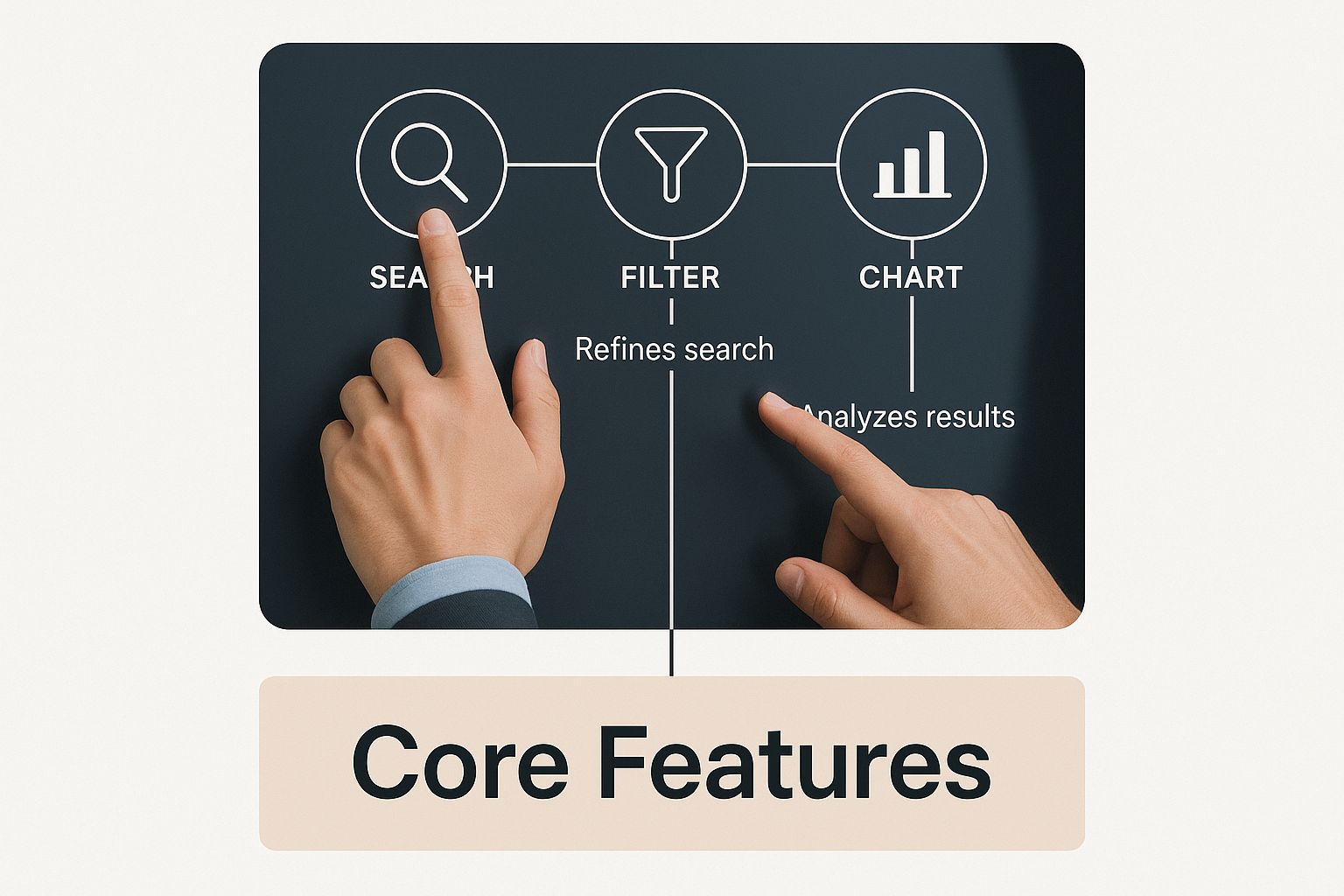
Using these filters, you can cut through the noise of thousands of companies and zero in on the handful that are a perfect match for what you sell.
Firmographics: The Lay of the Land
Firmographics are the absolute basics—the "who, what, and where" of a business. This is your ground floor, the essential data you need to even begin segmenting your market. Without this, you're just guessing.
- Industry and Niche: It’s one thing to know a startup is in "FinTech." It’s another thing entirely to know they specialize in "B2B payment processing for e-commerce." That level of detail is where the magic happens.
- Company Size: The number of employees is a classic, telling you a lot about a company's maturity and budget. A startup with 10 people has completely different growing pains than one with 100.
- Geographic Location: This is non-negotiable for sales teams with defined territories or anyone selling location-dependent services.
This data builds the foundation of your ideal customer profile. From this baseline, you can start layering on the really juicy details. A solid grasp of these fundamentals is critical before you even think about building out a complete B2B buyer persona template.
Before we get into more dynamic data, let's look at how much deeper a real database goes compared to a simple list you might buy or scrape.
Standard Contact List vs Startup Company Database
| Data Point | Standard Contact List | Startup Company Database |
|---|---|---|
| Industry | General (e.g., "Software") | Granular (e.g., "AI-powered logistics SaaS") |
| Funding | Not included | Detailed (e.g., "$10M Series A, last month") |
| Technology Used | Not included | Specifics (e.g., "Uses Salesforce, HubSpot") |
| Hiring Trends | Not included | Yes (e.g., "Hiring 5 new sales reps") |
| Decision-Makers | CEO name, maybe | Full C-suite with contact info & social links |
As you can see, one gives you a vague direction, while the other gives you a precise GPS coordinate for your sales efforts.
Funding Data: Follow the Money
Funding data is probably the single most powerful predictor of a startup’s intent to buy. When a company lands a big investment, that cash isn't just sitting in a bank account—it's rocket fuel for growth. It’s a budget specifically earmarked for new tools, bigger teams, and market expansion.
A recent funding round is a flashing neon sign that a company is about to go on a spending spree. For anyone in B2B sales, it’s the ultimate buying signal. It means they have a problem to solve and, crucially, the money to solve it.
Here’s what you should be looking for:
- Funding Stage: A Seed round means they’re building the foundation. A Series B or C round means they’ve found what works and are hitting the accelerator.
- Amount Raised: The size of the check is a great indicator of how big their plans are.
- Investors: Knowing a top-tier VC firm is backing them adds a layer of credibility and signals they're on a serious growth trajectory.
Technographics and Growth Signals: Reading the Tea Leaves
Technographics tell you what technology and software a company is already using. It’s like getting a peek inside their toolbox. If you sell a powerful marketing automation platform and you see a target is still using a basic email newsletter tool, that’s not just a lead—that’s a warm conversation waiting to happen.
Growth signals are the real-time clues. A sudden burst of hiring for sales roles? That tells you they’re scaling their revenue team and will almost certainly need sales enablement software, training, or lead-gen tools. These signals are about what a company is doing right now, giving you the perfect opening to start a conversation.
How a Database Can Reshape Your B2B Sales Game

Knowing what data points a startup database contains is one thing. Actually using that data to fill your sales pipeline is where the magic really happens. For B2B sales teams, this kind of intel turns a high-volume guessing game into a precise, strategic operation.
It's the difference between cold calling a random list and connecting with a perfect-fit company at the exact moment they need you. This shift lets your reps focus their energy where it counts: on warm, qualified leads with a genuine, immediate need. They can stop wasting time on companies that are a dead end and start engaging prospects who are actively looking for a fix. That’s a game-changer for both efficiency and morale.
Turning Raw Data Into a Ready-to-Buy Lead
Let's walk through a real-world scenario to see how this plays out. Imagine you sell project management software. Your goal isn't just to find any startup; you need to find the ones overwhelmed by rapid growth and desperately needing to get organized.
First, you’d jump into the startup company database and filter for companies that recently closed a Series A funding round of over $5 million. This simple step immediately isolates businesses with fresh capital and an executive mandate to scale—and fast. They’ve got the budget and the pressure to invest in new tools.
Then, you can add another layer. You filter that list again, looking for companies that also posted job openings for more than 10 new engineers or product managers in the last month. This specific hiring trend is a massive tell. It signals expanding teams, increasing project complexity, and, most likely, a bit of chaos behind the scenes.
What you're left with is a highly focused list of companies that check all the right boxes:
- They just secured a big chunk of funding.
- They are growing their product and engineering teams like crazy.
- They are almost certainly feeling the pain that comes with scaling so quickly.
A startup database doesn’t just give you a name and number; it gives you the story behind the lead. It tells you why a company needs your product right now, so you can craft a message that hits home instantly.
Crafting an Outreach That Actually Works
With this insight, your outreach is no longer a generic pitch. Instead of leading with, "Hi, we sell project management software," you can open with something hyper-relevant.
For instance, you could say: "Congratulations on your recent funding and the major growth of your engineering team! We often see companies at your stage find that managing new projects and onboarding developers can get pretty chaotic. Our platform is built specifically to bring order to that chaos."
This approach proves you’ve done your homework. You understand their specific challenges because the data showed you what was happening inside their business. You’re immediately positioned as a helpful advisor, not just another salesperson trying to make a quota. Learning these skills is key, and you can dive deeper into how to prospect effectively to sharpen your strategy.
A targeted approach like this doesn't just boost response rates—it shortens the entire sales cycle. You get to skip a lot of the initial discovery because you already know their main pain points. You’re starting the conversation on third base, which leads to faster deals and bigger wins. This is how sales teams stop working harder and start working a whole lot smarter.
How to Choose the Right Startup Database for Your Team
Picking the right startup database is a lot like choosing the right tool for a job. You wouldn't use a sledgehammer to hang a picture frame, right? In the same way, the best platform for your team completely depends on what you're trying to accomplish—whether that's hunting for investment deals, landing new B2B clients, or just keeping an eye on market trends.
With so many options out there, it’s easy to get overwhelmed. The trick is to start with your end goal and work backward. A venture capital firm looking for the next big thing needs deep financial data and investor profiles. A B2B sales team, on the other hand, needs seamless CRM integration and real-time buying signals to find companies ready to make a purchase.
Define Your Must-Have Features
Before you even glance at a price tag, make a checklist of your team's non-negotiables. This simple step helps you cut through the marketing fluff and compare different platforms fairly. Your list should zero in on the core features that will actually help your team win.
- Data Accuracy: How often is the information updated? Outdated data is a huge time-waster, so look for platforms that refresh their info daily or at least weekly.
- Coverage and Depth: Does the database actually cover your target industries and locations? Make sure it includes the specific data points you care about, like recent funding rounds, technology stacks, or hiring trends.
- Easy Integrations: Can it connect smoothly with the tools you already use, especially your CRM? A solid integration saves countless hours of manual data entry and keeps everyone on the same page.
- User-Friendly Design: Is the platform easy to figure out and navigate? If your team finds it clunky or confusing, they just won't use it—no matter how powerful it is.
Don't get distracted by a platform that offers a million features you'll never touch. The best startup database is the one that does a fantastic job at the specific things your team needs to hit its goals.
For instance, a well-known platform like Crunchbase gives you a broad overview of the entire startup world.
This screenshot shows how top-tier platforms provide a clean, simple interface to dig into company profiles, funding news, and market insights. The goal is to make a mountain of complex data easy to understand at a glance.
A Quick Look at a Leading Platform
A platform like Crunchbase gives you data on hundreds of thousands of companies, both public and private, all over the world. You can find detailed profiles with funding history, revenue estimates, and even the software they use. While the free version is a great starting point, the paid plans are where you'll find the serious research tools for prospecting and analysis. You can check out a full comparison of the top startup databases on Exploding Topics to see what else is out there.
Ultimately, the right choice has to fit your budget and your goals. Take a few platforms for a spin with a free trial. See which one feels right for your team's workflow before you commit.
Using Startup Data to Spot Global Market Trends
A top-tier startup company database does so much more than just hand you a list of leads. It gives you a bird's-eye view of the entire global economy, letting you see the forest for the trees. When you analyze all that data together, you can stop focusing on one company at a time and start understanding where the entire world of innovation is headed.
Think of it like being an economic weather forecaster for the startup world. Instead of just seeing one company's funding round, you can zoom out and see which industries or even which cities are pulling in the most investment. This big-picture perspective is a goldmine for planning your next move, expanding into new markets, and spotting opportunities long before they hit the mainstream.
Mapping the Global Innovation Landscape
The startup world is constantly shifting. Innovation hubs rise, and sometimes they fall. One year, a particular city might be the undisputed king of a tech sector, but the next, a new challenger pops up on the other side of the world. A great database lets you track these changes as they happen.
For example, a recent analysis from the Global Startup Ecosystem Report 2025 highlighted some major shake-ups in the world's top tech hubs. The report, which crunched data from five million startups, showed London dropping to third place globally for the first time since 2019. At the same time, Boston jumped back into the top five, and Bengaluru, India, made an incredible leap up seven spots to 14th. This is exactly the kind of data that shows you where the momentum is. You can dig into these global ecosystem shifts on Startup Genome.
By tracking things like total funding, hiring patterns, and new company creation rates across different regions, a startup database can put emerging startup ecosystems on your radar. This lets you get in on the ground floor, way before a market gets crowded and competitive.
Turning Macro Trends into Actionable Strategy
Getting a handle on these global currents isn't just some interesting academic exercise—it has real, practical uses for any business that wants to grow. This high-level view is crucial for making smart decisions and is a core part of any solid market analysis.
This kind of strategic thinking is fundamental to effective competitive intelligence gathering. Here’s how you can turn these broad insights into concrete actions:
- Spot Expansion Opportunities: Let's say you notice a huge spike in FinTech startups popping up across Southeast Asia. That could be a massive sign that there's an underserved market for your financial software, pointing you directly toward your next international move.
- Allocate Resources Smarter: If the data shows a slowdown in a region where you’ve been spending heavily, you can make the call to pull back and redirect those sales and marketing dollars to a more promising, high-growth area.
- Guide Product Development: Seeing a bunch of new AI startups all focused on sustainability? That might just be the spark you need to develop a new feature or product that perfectly serves this well-funded and growing niche.
When you use a startup database for this kind of high-level analysis, you're building a smarter, more adaptable business strategy. You aren't just finding customers for today—you're setting your company up to win in the markets of tomorrow. You can learn more about how to build a competitive intelligence gathering strategy that keeps you one step ahead.
Your Top Questions About Startup Databases, Answered
Alright, so you get what a startup database is, but you probably still have a few practical questions. That’s smart. It's one thing to understand a tool in theory, and another to know how it actually works in the real world.
Let's dig into the common questions that pop up when sales teams are thinking about getting one. This is your final gut-check to make sure it’s the right move for you.
How Good Is the Data, Really?
This is the big one, and for good reason. The best providers are obsessed with data accuracy. They'll use a mix of smart tech and actual human researchers to find and double-check every piece of information. But let's be realistic—the startup world is chaotic. Things change overnight.
Because of this, no database can ever be 100% perfect. The good ones know this and fight back by refreshing their data constantly, often daily or at least every week.
When you're shopping around, press them on this. Ask exactly how they verify their data and how often it's updated. This is how you avoid wasting time on leads that have already gone cold.
Is This Going to Break the Bank for a Small Business?
Not at all. Most platforms know their audience and offer different pricing tiers to fit various budgets. Tools like Crunchbase even offer free or limited "freemium" plans, which are perfect for dipping your toes in the water without committing any cash.
For a small team, it's less about the price tag and more about the return. Think about it: if a database saves your team dozens of hours a month on manual grunt work and helps you land even one or two solid deals, it’s already paid for itself many times over. Always look for a provider that lets you try things out before locking you into a year-long contract.
It's not just about the cost; it's about the value. A great startup database should quickly become a profit center, not an expense, by feeding your team a stream of quality leads they can actually close.
Can I Hook This Up to My CRM?
You bet. In fact, if a database doesn't integrate with your CRM, that’s a major red flag. Top-tier platforms are built to play nicely with tools like Salesforce and HubSpot. They'll offer seamless connections that let you push company profiles, contact info, and buying signals straight into your pipeline.
This kind of automation is a game-changer. It gets rid of the soul-crushing task of copy-pasting data and makes sure your reps have the freshest intel right where they work. Before you sign anything, just double-check their list of integrations to make sure your setup is supported.
How Is This Different from LinkedIn Sales Navigator?
Great question. They might seem similar, but they're two different tools that work brilliantly together. LinkedIn Sales Navigator is all about finding and connecting with individual people. It’s the best tool out there for pinpointing the right decision-makers and starting conversations.
A startup database looks at the bigger picture—the company itself. It gives you the deep intel: who funded them, what tech they use, who’s on their board, and if they’re hiring like crazy.
Here’s a simple way to break it down:
- A startup database tells you which companies to go after and why.
- Sales Navigator tells you who to talk to when you get there.
The sharpest sales teams don’t choose one over the other. They use both in tandem to build a powerful, laser-focused outreach machine.