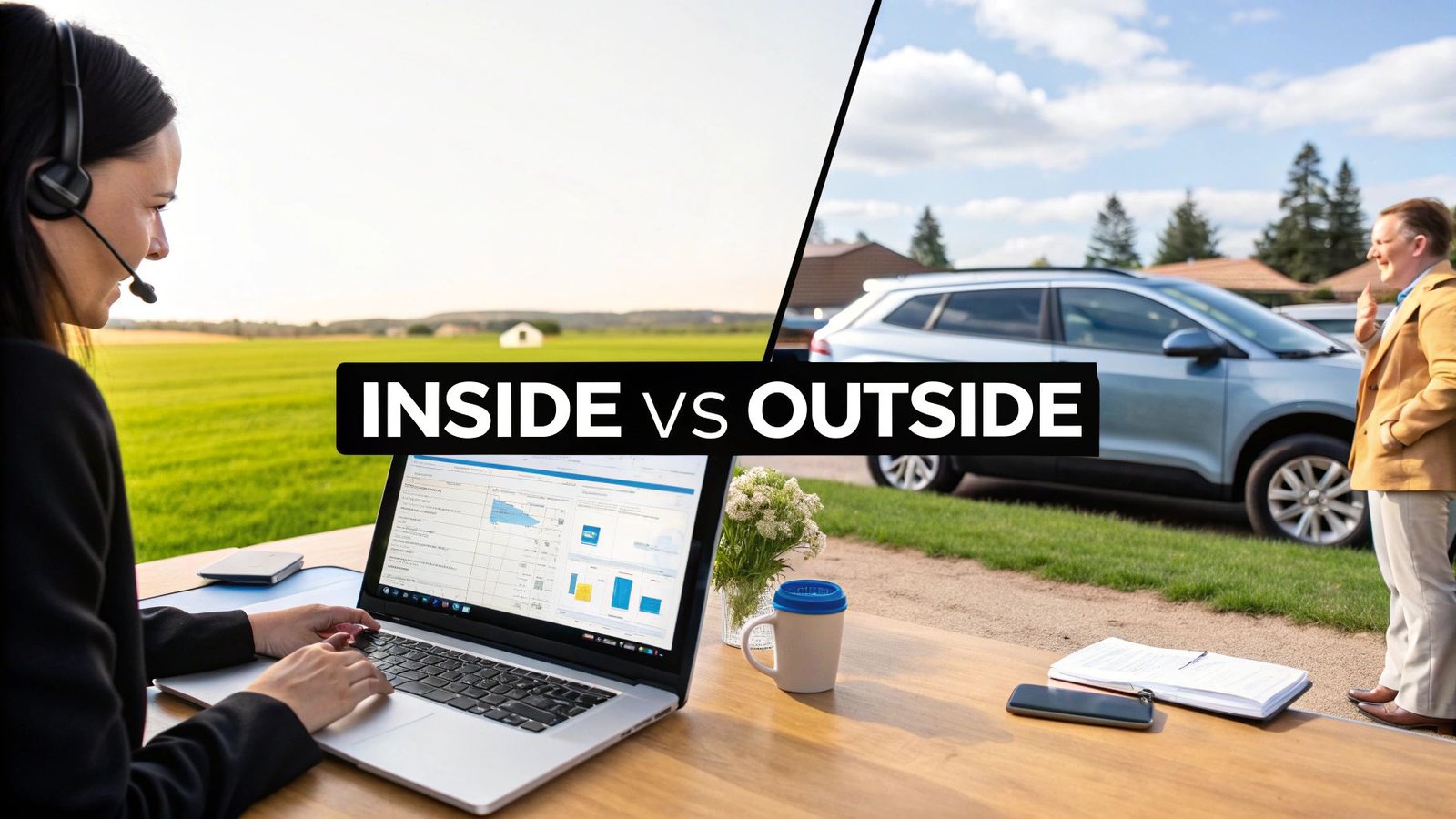
At its core, the difference between inside and outside sales comes down to where the selling happens. Inside sales reps work from an office, using phones, email, and video calls to connect with prospects. Outside sales reps are out in the field, meeting people face-to-face.
Choosing the right model isn't about which one is "better"—it's about what makes sense for your product, your customers, and your sales cycle.
Understanding the Two Sales Models

Before we can really compare them, let's get a clear picture of what each role looks like day-to-day. These aren't just two jobs with different locations; they represent fundamentally different philosophies for engaging with customers.
The Modern Inside Sales Rep
An inside sales rep works from a central hub, whether that's a company office or their home. Their entire world is digital. They use technology to manage a high volume of leads, running a fast-paced, efficient sales process from their desk.
A typical day for an inside sales rep is a flurry of activity:
- Hopping on video calls to run product demos.
- Sending out strategic follow-up emails.
- Making targeted calls with the help of a CRM and auto-dialer.
- Digging into data to see what’s working and what’s not.
This model is all about speed and scale. It’s incredibly cost-effective, which is why it's a go-to for many SaaS companies and businesses with a relatively straightforward sales process. If you want to dive deeper into finding the right people to call, check out this guide on how to prospect.
The Strategic Outside Sales Rep
On the other hand, an outside sales professional—often called a field rep—spends most of their time on the move. Their job is to build deep, personal relationships through in-person meetings.
The real power of outside sales is in that face-to-face connection. You can build a level of trust and rapport in person that's tough to match over a screen, which is absolutely critical for closing complex, high-ticket deals.
This approach is a perfect fit for products that need a physical demo, involve complex negotiations, or require nurturing a long-term relationship. Think enterprise software, heavy machinery, or medical devices—situations where the hands-on approach more than justifies the higher cost of travel and time.
A Quick Comparison of Sales Models
To really get a handle on inside versus outside sales, it helps to put them side-by-side. Each model has its own rhythm, its own costs, and ultimately, its own strategic purpose. Looking at them together makes it clear what you’re trading off when you choose one over the other.
The most obvious split is in the sales cycle and deal size. Inside sales is all about speed and volume. Reps are often closing a higher number of smaller deals, sometimes in just days or weeks. On the flip side, outside sales is a marathon, not a sprint. It’s a longer, more involved process geared toward landing those big, complex contracts that make the investment in travel and face-to-face time worthwhile.
Key Operational Differences
How your reps spend their day—and what it costs you—also looks completely different. Inside sales teams live in their digital toolkit. They’re masters of their CRM, video conferencing platforms, and email automation, all designed to churn through a high volume of leads efficiently. Your outside sales pros, however, need a budget for travel, client dinners, and the mobile tech that keeps them connected while they’re on the road.
This breakdown gives a great visual of the key performance stats, laying out the trade-offs in cost, speed, and close rates.
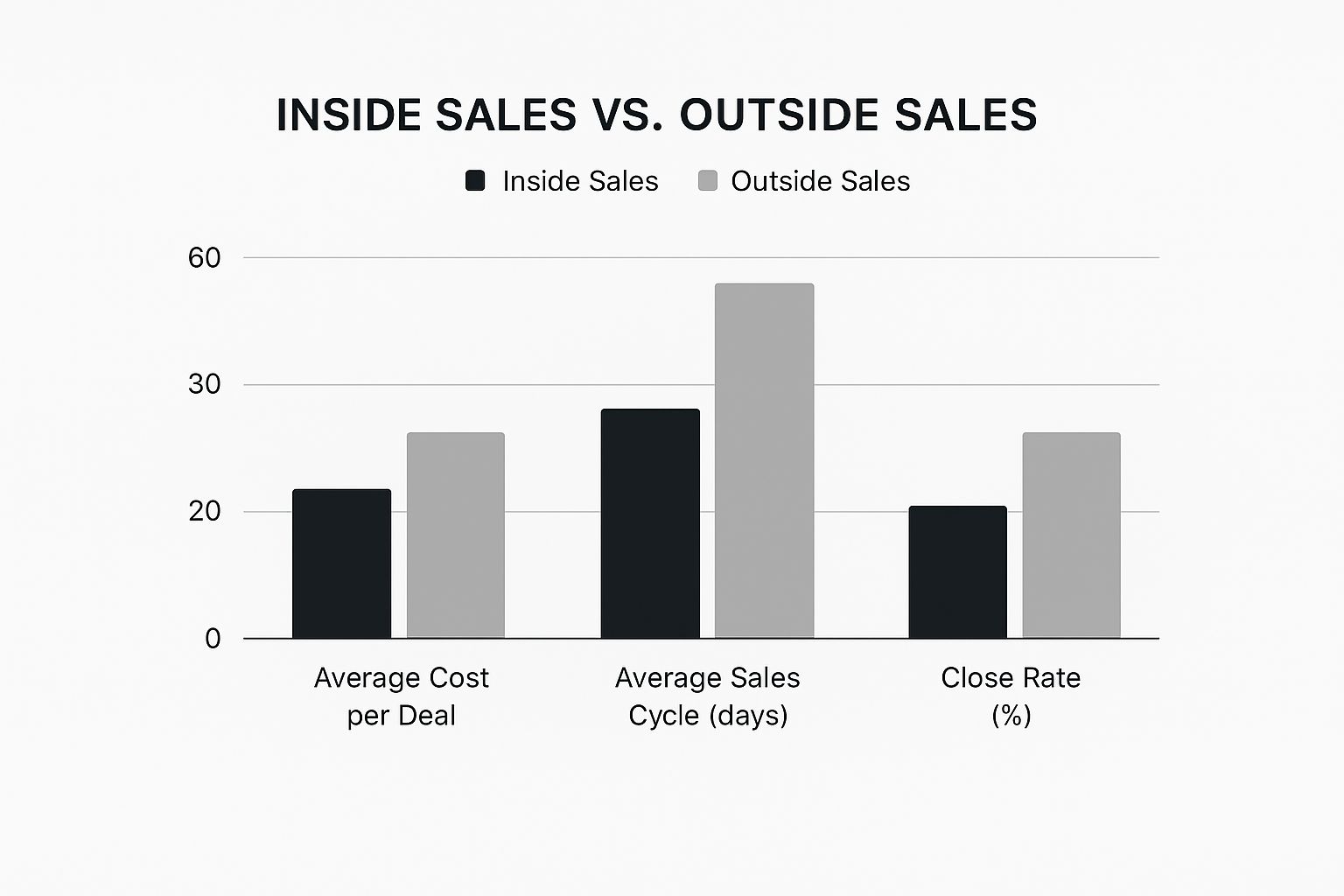
The numbers tell a clear story: while inside sales is lighter on the wallet and moves faster, outside sales still tends to pull in a higher close rate. That really speaks to its strength in complex, high-stakes negotiations.
The choice between inside and outside sales isn't just a tactical one—it's a strategic decision about how your company builds and maintains relationships. One is built for scalable efficiency, the other for deep, personal engagement.
To make it even clearer, here’s a table that boils down the essential traits of each model. Think of it as a quick reference guide.
Inside Sales vs Outside Sales At a Glance
This table offers a snapshot of the core characteristics that define each sales approach. It’s a simple way to see where they differ and helps frame the conversation around which model best fits your company's goals.
| Attribute | Inside Sales | Outside Sales |
|---|---|---|
| Primary Workplace | Office or remote desk | In the field, traveling to clients |
| Sales Cycle Length | Typically shorter (days or weeks) | Often longer (months or quarters) |
| Average Deal Size | Generally smaller, high volume | Typically larger, high-value deals |
| Customer Acquisition Cost | Lower | Higher due to travel and expenses |
| Key Tools Used | CRM, phone, email, video calls | Mobile CRM, travel apps, presentations |
| Main Focus | Lead volume and conversion speed | Building deep, long-term relationships |
| Common Industries | SaaS, tech, B2B services | Manufacturing, pharma, enterprise software |
Ultimately, this comparison provides a solid framework for deciding which approach—or perhaps a hybrid of the two—will drive the best results for your business.
Daily Roles and Strategic Functions

To really get what separates inside and outside sales, you have to look past the definitions and see what these pros actually do all day. Their routines, tools, and goals are worlds apart, shaped entirely by their environment. One role is all about digital efficiency and high volume; the other is built on personal connection and strategic patience.
The Inside Sales Playbook
An inside sales rep lives in a fast-paced, data-heavy ecosystem. Their whole mission is to juggle a massive number of leads as efficiently as possible, which makes technology their best friend. Their day isn't spent on the road—it's spent navigating digital dashboards.
Think about a typical day for an inside sales rep at a SaaS company. It probably looks something like this:
- Morning: Digging into the CRM to find warm leads who clicked on the latest email campaign.
- Mid-day: Hopping on back-to-back video calls for virtual product demos, fielding questions and handling objections on the fly.
- Afternoon: Powering through follow-up calls with an automated dialer and logging every single interaction in the CRM.
This entire workflow is engineered for speed and scale. It allows a small team to reach out to hundreds of prospects every single week. Success here depends on a structured, repeatable process. Reps use sales automation to take care of the busywork so they can focus on having real conversations. They're constantly watching metrics like open rates and demo attendance to see what's working, tweaking their scripts based on what the data tells them.
This model is a perfect fit for products with shorter sales cycles and lower price points, where it just isn’t practical to build a deep, personal relationship with every prospect. The name of the game is to qualify leads fast and push them through the pipeline with precision.
Inside sales is fundamentally about leverage—using technology to multiply a rep's ability to engage, educate, and convert leads at scale. It transforms sales from an art of persuasion into a science of process optimization.
The growth here has been explosive. Better tech and changing buyer habits have fueled the fire. Between 2017 and 2025, the percentage of inside sales reps on high-growth B2B teams shot up from about 10% to 40%. This isn't just a trend; it's a major market shift. As this insightful comparison shows, inside sales teams are often hitting 9.8% higher quota attainment than their colleagues in the field.
The Outside Sales Mission
On the flip side, the outside sales professional operates with a completely different playbook. Their role is less about the number of leads they contact and all about cultivating a few high-value, long-term relationships. Success isn't measured in calls per day, but in the strength of the partnerships they build.
Take an outside sales rep for a medical device company. Their focus is on strategic territory management, and their calendar is full of face-to-face meetings, not Zoom calls.
A typical week might involve:
- Traveling to different hospitals across their designated region.
- Giving on-site demonstrations of complex surgical equipment to surgeons and hospital administrators.
- Attending industry conferences to network and build rapport with key decision-makers.
- Negotiating complex, multi-year contracts that involve navigating a maze of procurement rules.
This job demands serious people skills, a high degree of autonomy, and the ability to think on your feet. The goal is to become a trusted advisor—someone the client can't imagine working without. While the costs for travel and entertainment are higher, they're easily justified by the massive deal sizes and incredible customer lifetime value they bring in.
Breaking Down the Costs and ROI

Deciding between an inside and outside sales model isn't just about strategy—it's a major financial commitment. Each approach has a completely different financial footprint, and a quick cost-benefit analysis will show you exactly where your money is going and what kind of return you can realistically expect.
Understanding these costs is the first step toward building a sales engine that actually lasts. For an inside sales team, the expenses are fairly predictable and mostly revolve around tech and office space. On the flip side, an outside sales team's budget is a lot more fluid, with most of the cash going toward travel and top-tier salaries.
The Lean Economics of Inside Sales
The inside sales model is built from the ground up for financial efficiency. Costs are consolidated, predictable, and tied directly to how productive your team is. This setup is a huge plus for businesses needing to scale up without a massive upfront investment.
Here's where the money typically goes for an inside sales team:
- Salaries and Commissions: Base salaries for inside reps are competitive, but they're generally lower than what you'd pay a field rep.
- Technology Stack: This is a big one, but it's non-negotiable. Think subscriptions for your CRM, auto-dialers, sales engagement tools, and video conferencing software.
- Office Overhead: This covers the basics like the physical workspace, utilities, and the IT support needed to keep everything running.
The return on investment (ROI) for inside sales really shines when you look at its low cost-per-lead and faster sales cycles. Since reps can connect with a high volume of prospects every single day, the cost to bring in each new customer stays low. If you want to dig into the numbers, our guide on calculating your SaaS customer acquisition cost is a great place to start. This inherent efficiency is what makes rapid, scalable growth possible.
The beauty of the inside sales model lies in its predictability. Costs are largely fixed, allowing leaders to forecast budgets accurately and scale operations by simply adding more reps and software licenses.
This controlled spending makes it much easier to calculate ROI and justify putting more money back into the team. The financial model is simple: give your team the tools to be more efficient, and they’ll generate more revenue without a proportional spike in costs.
The High-Value Investment of Outside Sales
While inside sales is all about efficiency, the outside sales model is an investment in high-touch, high-value relationships. Yes, the operational costs are significantly higher, but they are often justified by the potential for landing bigger, more complex deals and securing a much higher customer lifetime value (LTV).
The cost structure for outside sales is far more dynamic and comes with its own unique expenses:
- Higher Base Salaries: Field reps command larger salaries to compensate for the constant travel and the demands of strategic account management.
- Extensive Travel Budgets: This is your biggest variable cost, covering everything from flights and hotels to rental cars and meals on the road.
- Client Entertainment: Building real rapport often means dinners, industry events, and other expenses designed to foster a strong connection.
- The Hidden Cost of Transit: Time spent in a car or on a plane is time not spent selling, which is a significant opportunity cost to factor in.
Make no mistake, the operational costs for outside sales are steep. Travel, lodging, and entertainment can eat up a huge chunk of the budget, meaning every deal needs to deliver a solid profit margin. In fact, outside sales reps typically earn about 36% higher base salaries than their inside sales colleagues.
With outside sales, ROI isn't measured by call volume. It’s measured by the size and quality of the deals closed. That massive investment pays off when a single signed contract is worth millions. These reps are masters at navigating complex buying committees and securing the kind of long-term enterprise partnerships that an inside team would find nearly impossible to land.
Choosing the Right Sales Model for Your Business
Picking between an inside and outside sales model is one of the most important calls you'll make for your business. This isn't just about saving money or making things convenient; it’s about matching your sales team's structure to your product, your customers, and your company's future. Get it right, and you create a smooth path to growth. Get it wrong, and you'll burn through resources and miss out on good opportunities.
The decision really boils down to three things: how complex your product is, what your average deal is worth (ACV), and what your ideal customer actually needs. Each of these will point you toward the model that’s most likely to work for your specific situation.
Look at Your Product and Who You're Selling To
First things first, you need to be honest about what you sell and who buys it. A simple, low-cost product that people buy quickly is a completely different ballgame than a complex, expensive solution that takes months of back-and-forth.
For instance, a SaaS company with a simple project management tool for small businesses is a perfect fit for an inside sales team. The product is easy to show off in a virtual demo, the price is manageable, and the buyers are already used to doing business online. Here, the name of the game is volume and speed—exactly what an inside sales team is built for.
On the other hand, if you’re selling specialized manufacturing equipment or a sophisticated cybersecurity system for large enterprises, you need a different playbook. These deals often require on-site demos, deep technical conversations, and building real trust with a whole committee of decision-makers. This is where outside sales reps shine. That high-touch, face-to-face approach is essential to navigate the complexity and justify the huge price tag.
The real difference between inside and outside sales isn't just about where the reps are located. It's about efficiency, the complexity of the deal, and how you segment your customer base. Inside sales is built for speed with straightforward products, while outside sales is designed for complex deals that demand customization and real relationships. You can find more insights on this at RepMove.app.
Consider Your Contract Value and Sales Cycle
Your average contract value is a huge tell. An outside sales team costs a lot more to run—think travel, higher salaries, and client dinners. To make that investment worthwhile, the deals they bring in have to be big.
When to lean toward outside sales:
- High ACV: Your average deal is large enough to easily cover the higher cost of acquiring that customer.
- Long Sales Cycles: The sales process drags on for months, sometimes even years, requiring a steady, personal touch.
- Complex Negotiations: Contracts bounce between departments, involve custom setups, and get a thorough legal review.
When to lean toward inside sales:
- Lower ACV: Your product's price point demands a high-volume, low-cost sales strategy to be profitable.
- Short Sales Cycles: Customers can decide whether to buy in a matter of days or weeks.
- Transactional Sales: The buying process is pretty simple and doesn't require much haggling.
Trying to sell a high-ACV product with only an inside team often fails because you can't build the deep trust needed for a major purchase. On the flip side, sending an expensive outside rep to close a low-ACV deal is a fast track to losing money. The math has to work.
Why Not Both? The Power of a Hybrid Model
For a lot of companies today, the answer isn’t choosing one or the other. It's about creating a smart mix of both. A hybrid sales model takes the best of each approach to build a more efficient and powerful sales pipeline.
In a well-run hybrid setup, the roles are crystal clear, letting each team do what it does best:
- Finding and Qualifying Leads (Inside Sales): The inside sales team kicks things off. They handle the initial outreach, field incoming leads, and run the first round of discovery calls and demos. Their job is to quickly sort through a ton of prospects to find the ones with real potential.
- Closing the Big Deals (Outside Sales): Once a lead is properly qualified and looks like a major opportunity (say, an enterprise account), it’s handed off to an outside sales rep. This field rep takes over, setting up in-person meetings, running detailed on-site demos, and handling the tricky negotiations to get the deal signed.
This division of labor is a game-changer. It lets your inside team focus on speed and scale, while your highly-skilled (and more expensive) outside reps can dedicate all their time to high-stakes, big-ticket deals. It ensures your best people are always aimed at your best prospects.
How to Measure Success: Key Metrics and Tools for Each Model
When it comes to measuring success in inside and outside sales, you can't just use the same ruler. Each approach operates on a completely different rhythm and aims for different kinds of wins. Trying to apply inside sales metrics to an outside team (or vice-versa) is a recipe for confusion.
Think of it this way: an inside sales team is running a sprint. It's all about volume, speed, and efficiency. They need to turn a high number of activities into a steady stream of closed deals. An outside sales team, on the other hand, is running a marathon. Their success is judged by the depth of their relationships and the sheer value of the deals they land over a much longer race.
Key Performance Indicators for Inside Sales
For inside sales, the game is all about activity and conversion. You need a crystal-clear, data-driven view of your sales funnel to see where things are getting stuck and where your reps need coaching. The entire focus is on actions you can count—actions that lead straight to revenue.
Here are the numbers that really matter:
- Call Volume and Connect Rate: It's simple, but it's fundamental. How many calls are your reps making? And more importantly, how many of those calls actually turn into a conversation with a real person? This tells you a lot about their raw effort and ability to get past gatekeepers.
- Lead Response Time: In the fast-paced world of inside sales, every single minute counts. Tracking how fast a rep jumps on a new lead is absolutely critical. The data doesn't lie: faster response times directly correlate with higher conversion rates.
- Sales Cycle Duration: How long does it take to get a lead from that first "hello" to a signed contract? A shorter sales cycle is a sign of an efficient machine, bringing in revenue faster.
- Conversion Rate by Stage: This is where you diagnose the health of your sales process. By watching the percentage of leads that progress from one stage to the next, you can instantly spot where deals are dying on the vine. To really dig into this, our guide on what is sales pipeline management is a great resource.
You can't track any of this without the right tech. Inside sales teams live and die by their tech stack. A powerful CRM like Salesforce is the brain, while sales engagement platforms like Outreach or Salesloft act as the muscle, and auto-dialers provide the speed.
Crucial Metrics for Outside Sales
Tracking an outside sales team means shifting your focus from high-volume activities to high-value outcomes. These reps are nurturing fewer, but much larger, accounts. Their metrics need to reflect the quality of their relationships and the overall profitability they bring to the business.
For outside sales, success isn't just about closing a deal; it's about the long-term value that deal brings. Metrics should reflect the strategic investment made in each client relationship, not just the raw number of meetings.
These are the metrics that tell the real story for field reps:
- Customer Lifetime Value (LTV): This is the holy grail for outside sales. It measures the total revenue a company can realistically expect from a single customer over the entire relationship. A high LTV is what justifies the significant investment of time and resources.
- Cost of Customer Acquisition (CAC): With travel, dinners, and events, the costs can add up quickly. Understanding exactly how much you're spending to land each new client is essential for making sure your strategy is actually profitable.
- Territory Win Rate: This gauges how effective a rep is within their assigned patch. It helps sales leaders figure out if they’re getting good market penetration or if it’s time to reallocate resources.
- Average Deal Size: A straightforward but powerful metric. It keeps track of the value of the contracts being signed, ensuring the team stays focused on the big, high-impact opportunities that define outside sales.
The toolkit for an outside sales rep is built for life on the road. They need technology that keeps them connected and organized while they're away from a desk. Think mobile CRM apps, route planning software like Badger Maps to make travel more efficient, and simple expense tracking systems to keep budgets in check.
Frequently Asked Questions
Got questions about inside and outside sales? You're not alone. Let's tackle some of the most common ones that come up when leaders are trying to structure their sales teams.
Can a Company Use Both Sales Teams?
Yes, and honestly, most modern sales organizations do. This "hybrid" approach is incredibly effective because it lets you play to the strengths of both models.
Think of it like a relay race. Your inside sales reps are often the sprinters who start the race. They’re fantastic at qualifying leads, running initial demos, and nurturing smaller accounts that don't need a face-to-face meeting. They build the initial momentum.
Once a lead shows serious potential or is a major enterprise account, they pass the baton to the outside sales team. These are your long-distance runners, the closers who build deep relationships in person, navigate complex negotiations, and win those big, strategic deals. This division of labor is just plain smart and efficient.
Is One Sales Model Becoming Obsolete?
Not a chance. Their roles are definitely changing, but neither is going away. The rise of digital tools has supercharged inside sales, making it more powerful and popular than ever, especially since many buyers now prefer to start the conversation online.
But for big-ticket items, complex solutions, or industries built on long-term trust, you simply can't replace the power of a face-to-face meeting. Outside sales is still the gold standard when a handshake and personal connection can make or break a million-dollar deal.
The real shift isn't about one model replacing the other. It’s about smart integration. The best sales leaders don't ask, "Which one should we use?" They ask, "How can we blend them to perfectly match our product, our market, and our customers' buying journey?"
The future isn't about choosing one over the other; it’s about creating a flexible, intelligent system that uses the right approach for the right situation.
What Are the Key Skills for Each Role?
While both roles are about selling, the day-to-day reality—and the skills needed to succeed—are worlds apart.
-
For Inside Sales Reps: Success is all about discipline and digital dexterity. They need to be masters of their CRM, lightning-fast with email and on the phone, and incredibly organized to handle a high volume of leads. They must be pros at building rapport without ever shaking a hand.
-
For Outside Sales Reps: This is a game of autonomy and relationship-building. These reps have to be self-starters who can manage their own territory and schedule. They excel at reading a room, building genuine trust face-to-face, and navigating the complex politics within a client's organization. They need resilience and the ability to think strategically on their feet.